
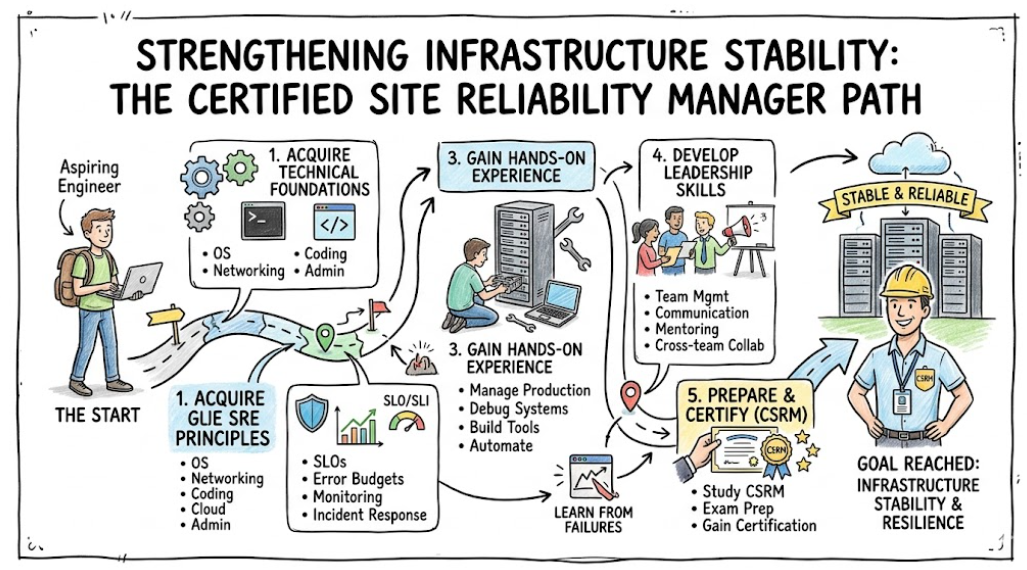
In the complex world of software delivery, the challenge isn't just shipping code—it is ensuring that code remains operational under high demand. For engineers looking to formalize their expertise in system health, the Certified Site Reliability Manager program provides a clear, actionable roadmap. By grounding your workflow in proven engineering principles through SREschool.com, you transition from firefighting to building systems that are inherently resilient.
Understanding the Certified Site Reliability Manager
The Certified Site Reliability Manager is a program that teaches you how to treat infrastructure as an extension of the software development process. It moves the focus away from manual, repetitive tasks—often called "toil"—and toward automated, scalable design. The goal is to build services that prioritize availability and performance, even when systems are pushed to their limits.
Who Should Pursue Certified Site Reliability Manager?
This career path is essential for those who want to ensure long-term system health:
- Platform Engineers: Dedicated to building the robust foundations that host applications.
- DevOps Engineers: Seeking to integrate deeper reliability metrics into their CI/CD pipelines.
- Software Developers: Who want to understand how their applications behave in a production environment.
- Infrastructure Managers: Responsible for maintaining high uptime for critical business services.
- System Administrators: Transitioning toward more automated, code-driven operations.
The Value of Certified Site Reliability Manager
As modern architecture shifts toward microservices and distributed clouds, the cost of an outage has never been higher. Holding this certification proves you can navigate these complex environments. It signals to employers that you know how to quantify reliability using service level objectives and how to use error budgets to balance innovation with uptime. It is a strategic shift from being a reactive administrator to a proactive reliability engineer.
Certified Site Reliability Manager Certification Overview
Delivered through an official portal, this certification program provides a structured way to validate your skills. It ensures you understand the theory while requiring you to apply that knowledge to real-world technical problems, making it a perfect fit for engineers who prefer practical, results-driven learning.
Certified Site Reliability Manager Certification Tracks & Levels
To help you grow systematically, the program is divided into manageable levels.
| Track | Level | Who it is for | Prerequisites | Skills Covered | Recommended Order |
|---|---|---|---|---|---|
| Foundations | Entry | Beginners | Basic Linux | Monitoring, SLOs | 1 |
| Professional | Mid-level | Engineers | Foundation Cert | Automation, Toil | 2 |
| Advanced | Senior | Leads | Professional Cert | Scaling, Resilience | 3 |
Detailed Guide for Each Certified Site Reliability Manager Certification
Foundations Level
- What it is: The building blocks of reliability engineering.
- Who should take it: Anyone starting their journey into SRE.
- Skills you will gain: Basic observability, alerting, and service levels.
- Real-world projects: Configuring a standard monitoring dashboard.
- Preparation plan: 7 days.
- Common mistakes: Underestimating the importance of clear logging.
- Next certification: Professional Level.
Professional Level
- What it is: Managing workloads in active production settings.
- Who should take it: Experienced DevOps and SRE practitioners.
- Skills you will gain: Managing error budgets and automating manual remediation.
- Real-world projects: Developing a functional incident response runbook.
- Preparation plan: 30 days.
- Common mistakes: Prioritizing new features over system stability.
- Next certification: Advanced Level.
Advanced Level
- What it is: Architecting for large-scale, high-resilience systems.
- Who should take it: Senior architects and team leads.
- Skills you will gain: Disaster recovery modeling and capacity forecasting.
- Real-world projects: Designing a failover strategy for a global application.
- Preparation plan: 60 days.
- Common mistakes: Creating overly complex architectures that are hard to maintain.
- Next certification: Leadership tracks.
Choose Your Learning Path
- DevOps Path: Aligning reliability with continuous delivery goals.
- DevSecOps Path: Ensuring security doesn't compromise system availability.
- SRE Path: A deep dive into observability and incident management.
- AIOps Path: Using machine learning to optimize infrastructure monitoring.
- MLOps Path: Keeping machine learning pipelines reliable and performant.
- DataOps Path: Ensuring that data flows are consistent and highly available.
- FinOps Path: Balancing high uptime with cloud cost optimization.
Role → Recommended Certified Site Reliability Manager Certifications
| Role | Recommended Certifications |
|---|---|
| SRE | Foundations + Professional |
| DevOps Engineer | Professional + Advanced |
| Systems Architect | Advanced |
| IT Manager | Foundations |
Next Certifications to Take After Certified Site Reliability Manager
After establishing your reliability baseline, you can expand into advanced security domains, AI-driven operations, or specialized leadership roles that focus on the intersection of business strategy and technical infrastructure.
Why Certified Site Reliability Manager Matters for Your Audience
For the GitSpot community, version control and code quality are the starting points, but production reliability is where those efforts are tested. This certification gives you the structured framework to manage your systems with the same rigor you apply to your code. It provides the methodology to automate away manual tasks, ensuring your time is spent on solving difficult problems rather than addressing routine outages.
Training & Certification Support Providers for Certified Site Reliability Manager
DevOpsSchool emphasizes technical hands-on experience, ensuring that students can apply their knowledge directly to real-world production environments. Their training is designed for professionals who want to move beyond simple theory and gain the practical skills needed to keep complex systems running efficiently.
Cotocus specializes in creating focused learning modules that cater to the fast-paced needs of modern engineers. They provide clear, concise certification pathways that help you acquire the necessary reliability engineering skills without getting bogged down in unnecessary theory, making them ideal for professionals with busy schedules.
Scmgalaxy provides a structured, academic approach to reliability, focusing on the core architectural principles that define a stable system. Their resources are excellent for those who want to understand the fundamental 'why' behind system design and incident management, providing a strong foundation for any career path.
BestDevOps focuses on bridging the gap between developers and operational requirements. Their training programs are designed to help you adopt the mindset required for successful site reliability management, offering the resources necessary to prepare for and pass certification exams with confidence.
DevSecOpsSchool integrates the principles of security into the reliability framework. This is a critical combination for engineers working in environments where data protection is a top priority. Their training helps you manage system uptime without creating security vulnerabilities, a key skill in today’s landscape.
SREschool.com is the go-to provider for specialized, deep-dive reliability education. Their programs are comprehensive, covering everything from the basics of monitoring to advanced system architecture. This is the primary destination for anyone dedicated to building a career specifically in site reliability engineering.
AIOpsSchool offers specialized training in utilizing AI-driven tools to enhance infrastructure monitoring. Their courses are perfect for those who want to move beyond manual alerting and into the world of intelligent, automated diagnostics, a must-have skill for managing large-scale services.
DataOpsSchool provides the training needed to ensure that data-heavy pipelines remain functional and available. Their specific focus on data reliability makes them an essential partner for engineers who are tasked with maintaining the integrity and availability of information in modern enterprise settings.
FinOpsSchool teaches the essential skill of cloud cost-awareness within the context of reliability. They show you how to maintain high-performance, stable systems while also ensuring that your resource usage is optimized, helping you to make architectural decisions that are both technically and financially sound.
Frequently Asked Questions (General)
- What is the main objective of this certification? To teach engineers how to build and maintain stable, scalable systems.
- Is this credential recognized industry-wide? Yes, it is a well-respected standard for reliability professionals.
- Are there practical labs included in the training? Yes, hands-on application is a core part of the curriculum.
- Can software developers benefit from this? Yes, it helps them write code that is more production-ready.
- How long does the training take? It depends on your current experience and chosen learning path.
- Are there any prerequisites? A working knowledge of Linux and networking is usually recommended.
- Is the course format flexible? Yes, most platforms offer self-paced learning options.
- How do I take the exam? The assessment is completed through an online platform.
- Will this improve my resume? It validates your specialized skills to potential employers.
- Is the investment worth it? For career-focused engineers, it is highly valuable.
- Is extra help available if I get stuck? Most providers offer support to help you succeed.
- Does the certification last forever? Maintaining current expertise usually involves periodic updates.
FAQs on Certified Site Reliability Manager (Focused)
- How is this different from regular DevOps training? It focuses purely on reliability and uptime.
- Does it cover how to handle outages? Yes, incident management is a key part of the training.
- Is this right for cloud environments? It is explicitly built for the challenges of cloud-native setups.
- What is an error budget? It is a metric used to balance the desire for speed with the need for stability.
- Does this apply to small teams? Reliability principles are scalable for any size of infrastructure.
- How much automation is covered? Automation is the primary tool used to reduce operational work.
- How does it prevent downtime? By focusing on proactive planning and robust monitoring.
- Can I apply these to legacy systems? The core logic of reliability is platform-agnostic.
Final Thoughts: Is Certified Site Reliability Manager Worth It?
The Certified Site Reliability Manager certification is a highly practical path for any professional aiming to master the complexities of system stability. It cuts through the marketing fluff to provide the real-world engineering rigor necessary to keep digital services running smoothly. For those who want to level up their career and become a reliable authority in infrastructure management, this program is a clear and effective choice.



Top comments (0)