
Introduction
The management of enterprise software systems has become increasingly difficult due to the rise of distributed architectures, cloud migrations, and microservices. Thousands of scattered metrics, logs, and alerts are generated every single second across modern corporate networks. When system outages happen, IT infrastructure teams are often completely overwhelmed by dashboard noise, making manual root cause isolation nearly impossible.
To solve this operational crisis, artificial intelligence for IT operations, commonly known as AIOps, is actively being adopted by global organizations. Machine learning models, big data processing pipelines, and automated remediation are combined by AIOps to predict, detect, and fix critical platform issues before end users are ever affected.
For technology practitioners who want to stay relevant, gaining structural knowledge in this field is an absolute necessity. A comprehensive overview of the entry-level credential designed to validate your knowledge of intelligent IT infrastructure systems is provided by this guide.
What is AIOps Foundation Certification
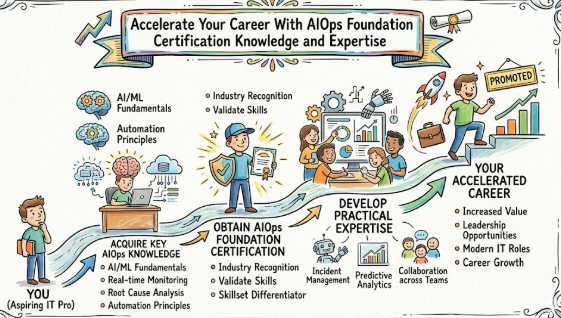
The AIOps Foundation Certification is an entry-level professional credential that validates a candidate's fundamental understanding of artificial intelligence and machine learning applications within modern IT operations. It acts as a structural stepping stone for software professionals who need to move away from old-fashioned, reactive system monitoring and transition toward predictive, automated IT infrastructure management.
Important operational topics such as statistical anomaly detection, algorithmic alert grouping, time-series data forecasting, and the structural principles of self-healing software environments are covered by the core curriculum of this program.
Why It Matters Today?
The traditional monitoring tools that rely heavily on static human-configured thresholds are no longer sufficient for complex cloud-native networks. When millions of data events are processed simultaneously, manual troubleshooting by human operators introduces severe delays, leading to extended platform downtime and devastating revenue losses.
Organizations across the globe are rapidly restructuring their technical operations teams to prioritize predictive intelligence. By understanding how to apply algorithmic data analytics to operational pipelines, engineering professionals can actively eliminate alert fatigue, accelerate system recovery times, and ensure long-term digital system resilience.
Why AIOps Foundation Certification Certifications Are Important
A structured, vendor-neutral framework is provided by this professional certification to help engineers formally master the core concepts of automated IT analytics. Having your skills validated by an industry-recognized program ensures that your knowledge is aligned with global operational standards.
It provides clear professional validation that a practitioner knows exactly how to ingest system logs, apply machine learning models to telemetry data, and implement automated runbooks safely, making certified individuals highly sought after by top-tier enterprise employers.
Why Choose AIOps School?
When looking to build a sustainable, high-growth career in modern infrastructure analytics, choosing the right educational provider is a critical decision. AIOps School is chosen by thousands of global engineering professionals for several distinct reasons:
- Production-Focused Curriculum: Instead of teaching abstract mathematical theories or pure coding syntax, the educational tracks are built entirely around real-world infrastructure failures, system patterns, and actual corporate operational scenarios.
- Comprehensive Career Pathways: A structured learning journey is offered, guiding students seamlessly from introductory foundational concepts all the way up to advanced enterprise architecture design.
- Industry Aligned Standards: Every training blueprint and testing module is formulated in direct collaboration with active global infrastructure architects and site reliability directors, ensuring the skills you learn match current production environment requirements perfectly.
Certification Deep-Dive
What is this certification?
The AIOps Foundation Certification is the premier introductory credential designed to teach tech professionals how machine learning models and automated data ingestion pipelines are used to optimize IT system uptime and eliminate manual alert noise.
Who should take this certification?
This program is ideally designed for working Software Engineers, DevOps Engineers, Cloud Administrators, Platform Engineers, Site Reliability Engineers, and Technical Managers who want to integrate algorithmic data intelligence into their existing monitoring workflows.
Certification Overview Table
The structural tracks provided by the certification platform are outlined in the table below:
| Track | Level | Who it’s for | Prerequisites | Skills Covered | Recommended Order |
|---|---|---|---|---|---|
| AIOps Track | Foundation | Beginners, SREs, IT Staff | Basic IT Ops awareness | Event correlation, ML fundamentals, noise reduction | First |
| AIOps Track | Engineer | Mid-Level Practitioners | Foundational AIOps knowledge | Anomaly models, auto-remediation, monitoring stacks | Second |
| AIOps Track | Manager | Team Leads, Tech Managers | Understanding of IT systems | Vendor evaluation, ROI metrics, change management | Third |
| AIOps Track | Professional | Advanced Operators | Advanced operational skills | Enterprise strategy, tool selection, team training | Fourth |
| AIOps Track | Architect | Enterprise Designers | Deep engineering background | Multi-cloud design, scalability, system architecture | Fifth |
Skills You Will Gain
- Algorithmic Noise Reduction: The ability to group thousands of scattered system notifications into a single, actionable incident report.
- Log Pattern Identification: Understanding how unsupervised machine learning is applied to look through unformatted data logs and isolate system bugs.
- Predictive Performance Forecasting: Using historical time-series data models to accurately forecast system capacity exhaustion before a crash occurs.
- Self-Healing Architecture Principles: Designing automated operational loops that can detect, isolate, and safely fix minor server errors without human intervention.
Real-World Projects You Should Be Able to Do After This Certification
- Intelligent Incident Router Setup: Building an automated routing system that groups related application alerts and sends them directly to the correct engineering team.
- Time-Series Anomaly Detector Blueprint: Designing a baseline data model that monitors cloud resource utilization and highlights unusual infrastructure spikes.
- Automated Log Analysis Pipeline: Configuring a central data ingestion pipeline that scans system files for repeating error signatures.
- Self-Remediation Runbook Design: Creating a conditional automated workflow that restarts a jammed application container whenever specific system errors are flagged.
Preparation Plan
7–14 Days Plan
- Days 1–4: The core definitions of intelligent operations are studied. The core differences between traditional monitoring and algorithmic analysis are deeply reviewed.
- Days 5–8: Focus is placed on machine learning fundamentals, specifically how supervised and unsupervised algorithms are applied to telemetry datasets.
- Days 9–11: Event correlation techniques, noise reduction logic, and topology-aware alerting principles are closely reviewed.
- Days 12–14: Practice exams are taken repeatedly, and official study guides from the certification portal are thoroughly analyzed before the exam attempt is scheduled.
30 Days Plan
- Week 1: An hour each day is dedicated to studying the evolution of infrastructure management and the primary business drivers behind automated data processing.
- Week 2: Deep attention is paid to log analysis, metric stream management, and tracing configurations within cloud-native microservices.
- Week 3: Time-series forecasting models and predictive analytical concepts are systematically studied using available sample datasets.
- Week 4: Structural principles of autonomous remediation and automated feedback loops are reviewed. Mock tests are completed to achieve a consistent passing score above 70 percent.
60 Days Plan
- Month 1: The first two weeks are spent mastering data ingestion mechanisms and basic IT infrastructure architecture components. The remaining two weeks are used to explore how machine learning models classify system alerts.
- Month 2: Real-world event correlation scenarios are actively practiced in sandbox environments. Dedicated study time is allocated to understand error budgets, service level objectives, and automated runbook safety limits. The final week is fully focused on passing proctored practice exams.
Common Mistakes to Avoid
- Relying Solely on Theoretical Definitions: Failing to understand how data pipelines and machine learning algorithms interact with actual cloud infrastructure during an outage will make the practical exam scenario questions difficult to clear.
- Skipping Practice Test Sessions: Attempting the proctored exam without testing your knowledge against timed multiple-choice practice exams often leads to poor time management during the actual test.
- Ignoring Traditional Monitoring Concepts: Forgetting that algorithmic intelligence sits directly on top of traditional log aggregators and metrics collection tools can create gaps in your operational knowledge.
Best Next Certification After This
Same Track
The Certified AIOps Engineer credential is the most logical next step, as it transitions your career from basic theoretical knowledge into hands-on production system configurations and model deployments.
Cross-Track
The MLOps Foundation Certification should be pursued to broaden your data operations skills, as it teaches professionals how to build, deploy, and monitor machine learning lifecycles at scale.
Leadership / Management
The Certified AIOps Manager path is highly recommended for professionals who want to transition into strategic roles, as it focuses on team building, tool budget optimization, and vendor selection.
Choose Your Learning Path
DevOps Learning Path
This path is customized for cloud automation specialists who want to embed data-driven intelligence directly into their continuous integration and continuous delivery (CI/CD) pipelines. Automated quality gates and intelligent code deployment controls are focused on by this track, making it best for cloud developers aiming to build smarter software delivery loops.
DevSecOps Learning Path
This line of study is designed for security focused engineers who need to monitor enterprise systems for compliance and hidden vulnerabilities. Machine learning algorithms are leveraged within this track to isolate security anomalies and initiate automated threat isolation scripts, making it ideal for systems protection professionals.
Site Reliability Engineering (SRE) Learning Path
Maximum platform uptime and error budget optimization are prioritized by this pathway. Automated root cause isolation and self-healing system workflows are deeply explored, making it the perfect choice for production stability engineers who want to eliminate manual on-call tasks.
AIOps / MLOps Learning Path
This track is built specifically for data practitioners who bridge the gap between data science and systems engineering. Managing live machine learning pipelines, model drift monitoring, and automated retraining loops are covered, making it best for professionals handling production-grade AI platforms.
DataOps Learning Path
Continuous data quality, pipeline stability, and automated data flow tracking are focused on by this curriculum. It ensures that large corporate data streams remain clean and reliable, making it ideal for big data engineers and database infrastructure administrators.
FinOps Learning Path
Cloud cost transparency and automated budget allocation are the primary focus areas of this learning track. Predictive machine learning models are used to forecast cloud resource consumption patterns and eliminate cloud waste, making it the best option for financial analysts and cloud cost managers.
Role → Recommended Certifications Mapping
The ideal career certification progression based on specific technology roles is displayed in the table below:
| Professional Role | Recommended Foundation Program | Intermediate Milestone | Advanced Leadership Goal |
|---|---|---|---|
| DevOps Engineer | AIOps Foundation | Certified AIOps Engineer | Certified AIOps Architect |
| Site Reliability Engineer | AIOps Foundation | Certified AIOps Engineer | Certified AIOps Professional |
| Platform Engineer | AIOps Foundation | Certified AIOps Engineer | Certified AIOps Architect |
| Cloud Engineer | AIOps Foundation | Certified MLOps Foundation | Certified AIOps Professional |
| Security Engineer | AIOps Foundation | Certified AIOps Engineer | Certified AIOps Manager |
| Data Engineer | MLOps Foundation | Certified MLOps Engineer | Certified MLOps Architect |
| FinOps Practitioner | AIOps Foundation | Certified AIOps Manager | Certified AIOps Professional |
| Engineering Manager | AIOps Foundation | Certified AIOps Manager | Certified AIOps Professional |
Next Certifications to Take
- One Same-Track Certification: The Certified AIOps Engineer credential can be pursued to deepen your technical skills, as it validates practical competency in building real-time alert systems and deploying automated self-healing scripts.
- One Cross-Track Certification: The Certified MLOps Engineer program is an excellent cross-track selection, as it teaches practitioners how to safely manage the entire operational lifecycle of machine learning models in cloud-native production spaces.
- One Leadership-Focused Certification: The Certified AIOps Manager credential is the premier choice for aspiring leaders, focusing heavily on operational roadmapping, budget building, team structure, and vendor evaluation frameworks.
Training & Certification Support Institutions
- DevOpsSchool: Comprehensive, live instructor-led training packages and hands-on laboratory sessions are offered by this institution to help technical professionals master cloud-native automation frameworks and scale modern infrastructure stacks.
- Cotocus: Specialized technical consulting and customized bootcamps are provided to assist engineering teams in adopting advanced infrastructure monitoring methodologies and mastering data-driven cluster configurations.
- ScmGalaxy: A vast, global knowledge ecosystem featuring instructional tutorials, technical community forums, and comprehensive reference materials focused on configuration management and automated deployment systems is maintained by this site.
- BestDevOps: Tailored corporate training workshops and structured career guidance programs designed to help system administrators successfully transition into high-paying platform engineering roles are delivered by this platform.
- devsecopsschool.com: Deep technical instruction focused purely on embedding advanced automated security scanners, policy-as-code frameworks, and vulnerability tracking tools directly into cloud deployment lines is provided by this educational academy.
- sreschool.com: Educational programs dedicated strictly to site reliability engineering principles, error budget calculation, incident response management, and complex enterprise platform uptime optimization are delivered by this platform.
- aiopsschool.com: The definitive educational platform for automated operational analytics, providing structured professional certification programs and advanced sandbox training labs spanning across the entire modern AIOps and MLOps tech domains.
- dataopsschool.com: Specialized training pathways focused on data pipeline automation, data lifecycle governance, and continuous data quality monitoring are provided to help big data teams run efficient production systems.
- finopsschool.com: Practical learning tracks dedicated entirely to modern cloud financial management, automated cloud cost optimization, and predictive resource allocation strategies are offered to corporate engineering and financial leads.
FAQs Section
1. What is the overall difficulty level of the foundational examination?
The foundational test is structurally designed as an entry-level hurdle, making it highly accessible for candidates who possess a basic understanding of software systems and automated monitoring concepts.
2. What is the exact amount of time required to fully prepare for the test?
A dedicated study window of approximately 14 to 30 days is typically required by working technical professionals who can commit at least one hour of study time each day.
3. Are there any strict technical prerequisites required before registration?
No formal cloud or data engineering certifications are required beforehand, though a general familiarity with cloud computing concepts and basic logging systems is highly beneficial.
4. What is the recommended certification sequence for an absolute beginner?
The journey should always be initiated with the foundational program, followed sequentially by the engineer training tier, and completed with the professional or architect level designations.
5. What long-term career value is unlocked by gaining this credential?
High professional credibility is added to your resume, making your profile stand out during hiring rounds for high-paying platform engineering and modern infrastructure management positions.
6. Which specific job roles benefit the most from this training program?
System administrators, cloud infrastructure developers, site reliability specialists, platform architects, and engineering managers find this educational program highly valuable for their daily duties.
7. How long remains the formal validity of the cleared certificate?
A lifetime validity status is carried by this specific introductory certification, meaning no expensive annual renewal fees or retraining points are required to maintain your certified status.
8. How is the official certification exam delivered to candidates?
An online, securely proctored testing format is utilized, allowing engineers to comfortably clear the exam from any quiet location equipped with a functional web camera and stable internet access.
9. What is the total duration allowed to finish the exam?
A testing window of exactly 90 minutes is provided to all candidates, which offers ample time to carefully analyze and answer every multiple-choice question presented.
10. What is the required passing score to secure the official digital badge?
A minimum score of 70 percent must be secured by the applicant, which requires answering at least 42 out of the 60 multiple-choice questions correctly.
11. Does the curriculum include training on vendor-specific software tools?
No, a vendor-neutral philosophy is maintained across the foundational program, ensuring that the analytical skills and architectural principles learned can be applied to any monitoring stack.
12. Are digital badges provided for professional display upon clearing the test?
Yes, a verifiable secure digital badge is instantly generated upon passing, allowing you to easily showcase your verified credential across major networks like LinkedIn and GitHub.
Additional FAQs: AIOps Foundation Certification
1. What core topic is covered under the AIOps Foundation Certification?
The structural connection between artificial intelligence algorithms and enterprise IT monitoring pipelines is deeply explored by this foundational course.
2. Can the examination be cleared without prior machine learning coding experience?
Yes, because the primary focus of the foundational track is placed on conceptual understanding and strategic deployment rather than writing complex custom python code from scratch.
3. How does this course explain the concept of event correlation?
The practice of using algorithmic logic to automatically link related system errors together while stripping away redundant log noise during an active infrastructure outage is explained.
4. Are practice test questions included within the entry package price?
Yes, full access to comprehensive practice question sets and digital study guides is included within the initial purchase price to ensure thorough exam preparation.
5. How are the concepts of self-healing software frameworks evaluated?
Candidates are carefully tested on their understanding of automated runbooks, error tracking loops, and safe conditional rollbacks within production environments.
6. Why is topology-aware data analytics prioritized within the study plan?
Understanding the live dependencies between software services allows the platform to pinpoint the exact root cause of an outage, preventing engineers from chasing false leads.
7. Does this certification help technical managers in their daily duties?
Yes, because a clear, non-technical vocabulary is provided, helping managers accurately evaluate infrastructure tools and estimate the operational returns of automation projects.
8. Where can the official registration and testing guidelines be found?
The complete programmatic registration portal, pricing details, and testing schedules are hosted officially at aiops-foundation-certification
Testimonials
A major breakthrough in my operational understanding was achieved after clearing this certification. The event correlation principles were instantly applied to eliminate our team's daily alert noise.
— RohanDeep career clarity was gained by completing this foundational course. The structured material helped me confidently transition from a standard system administrator role into core platform engineering.
— AnanyaMy professional confidence grew exponentially after studying this curriculum. The predictive analytics concepts are now leveraged daily to forecast cluster resource limits before outages occur.
— VikramA clear, structured learning framework was delivered by this program. The self-healing loop concepts allowed our security team to design faster automated threat containment workflows.
— KavitaExceptional strategic value was provided by this foundational path. A clear technical vocabulary was gained, allowing me to optimize our software tool budget and guide our engineering teams effectively.
— Siddharth
Conclusion
The adoption of algorithmic operations is no longer an optional technological experiment; it has become a core requirement for running stable, modern software architectures. A verified, structurally sound pathway is provided by the AIOps Foundation Certification to help technology practitioners master the essential principles of data-driven IT automation.
Significant long-term career advantages are secured by professionals who proactively add intelligent monitoring capabilities to their technical skillsets. By structuring your career path around recognized training milestones and choosing trusted learning networks like AIOps School, you ensure your profile remains highly valuable, competitive, and fully prepared to lead modern enterprise infrastructure systems.



Top comments (0)