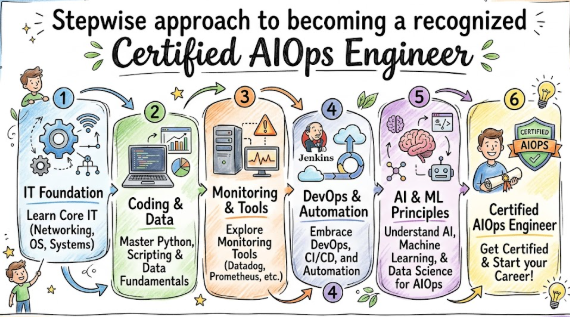
Introduction
Modern IT environments have grown incredibly complex. With the rise of cloud-native architectures, microservices, and massive data streams, manual oversight is no longer sufficient. Operational noise leads to engineer burnout and frequent system instability. This is where the Certified AIOps Engineer certification becomes a vital asset for your professional journey.
What is a Certified AIOps Engineer?
A Certified AIOps Engineer is a specialized professional trained to integrate artificial intelligence and machine learning into IT operations. This role marks the next evolution of traditional DevOps and SRE positions. Instead of reacting to outages, these engineers build intelligent systems that predict failures, automate root cause analysis, and manage infrastructure autonomously.
Why it matters today?
In today’s fast-paced digital economy, system uptime is the lifeblood of business. Traditional, rule-based monitoring tools often trigger thousands of false alerts, causing "alert fatigue." AIOps bridges the gap between data science and operations, allowing teams to filter noise, pinpoint critical issues, and resolve them before they impact users. It shifts the operational paradigm from manual firefighting to proactive, intelligent system management.
Why Certified AIOps Engineer certifications are important?
This certification provides a structured methodology to master the "intelligent" side of infrastructure. It validates your ability to design resilient, self-healing systems. As companies across India and the globe accelerate their digital transformation, professionals who can leverage AI to reduce operational costs and improve performance are in high demand.
Why choose AIOps School?
AIOps School is widely recognized for its hands-on approach. The institution focuses on real-world application rather than abstract theory. By choosing this school, you gain access to industry-expert mentors who have spent their careers in the trenches of IT operations. The training includes practical labs that allow you to simulate enterprise scenarios, ensuring that you are job-ready from day one. Their focus on the intersection of data pipelines and operational reliability makes their programs the gold standard for engineers looking to advance their careers.
Certification Deep-Dive: Certified AIOps Engineer
What is this certification?
This is a professional-level credential designed to validate your expertise in applying machine learning to IT infrastructure. It covers the entire lifecycle of an AIOps project, from data collection to predictive maintenance.
Who should take this certification?
This program is ideal for DevOps engineers, Site Reliability Engineers (SRE), cloud architects, and system administrators who want to modernize their skill sets and lead AI-driven operational teams.
Certification Overview Table
| Track | Level | Who it’s for | Prerequisites | Skills Covered | Recommended Order |
|---|---|---|---|---|---|
| AIOps Fundamentals | Entry | SysAdmins | Basic IT knowledge | Monitoring, Telemetry | 1 |
| AIOps Professional | Pro | DevOps/SRE | 1-2 years experience | ML, Log Analytics | 2 |
| AIOps Architect | Advanced | Senior Leads | 5+ years experience | System Design, AI Strategy | 3 |
| MLOps Integration | Pro | Data/Cloud Eng | DevOps basics | Model Deployment | 4 |
| FinOps for AIOps | Pro | Ops Managers | Cloud basics | Cost Optimization | 5 |
Skills you will gain
- Advanced event correlation and alert noise reduction.
- Implementation of real-time anomaly detection.
- Building automated remediation and self-healing scripts.
- Predictive analytics for capacity planning and performance forecasting.
- Data normalization and integration across complex IT stacks.
Real-world projects you should be able to do
- Develop an intelligent dashboard that correlates logs from multiple cloud services.
- Create a predictive model that identifies server failure patterns 30 minutes before an outage.
- Automate the root cause analysis process using AI-driven log correlation.
- Design a self-healing workflow for a Kubernetes cluster.
Preparation plan
- 7–14 days plan: Focus on core AIOps terminology, understanding data sources, and reviewing fundamental machine learning concepts applied to logs.
- 30 days plan: Dedicate time to hands-on lab exercises, mastering toolsets like ELK or Prometheus, and implementing basic anomaly detection scripts.
- 60 days plan: Build an end-to-end AIOps project from scratch, document your architecture, and conduct a peer review of your automated workflows.
Common mistakes to avoid
- Treating AIOps as a "silver bullet" rather than an operational methodology.
- Ignoring the importance of high-quality data ingestion.
- Focusing solely on tools instead of understanding the underlying logic of algorithms.
- Overlooking the importance of team collaboration and cultural shift.
Best next certification after this
- Same track: MLOps Professional.
- Cross-track: FinOps Certified Practitioner.
- Leadership / management: Certified Engineering Manager.
Choose Your Learning Path
- DevOps: Best for engineers looking to embed AI into CI/CD pipelines to predict deployment risks.
- DevSecOps: Ideal for security professionals wanting to use AI for automated threat detection and incident response.
- Site Reliability Engineering (SRE): Perfect for those focused on SLOs, error budgets, and system uptime.
- AIOps / MLOps: For specialists building the underlying data platforms and AI models for operations.
- DataOps: Suited for engineers managing complex data pipelines that feed into operational AI systems.
- FinOps: Best for professionals responsible for cloud cost optimization through intelligent resource management.
Role → Recommended Certifications Mapping
| Role | Recommended Certification |
|---|---|
| DevOps Engineer | Certified AIOps Engineer |
| Site Reliability Engineer (SRE) | Certified AIOps Engineer |
| Platform Engineer | Certified AIOps Architect |
| Cloud Engineer | Certified AIOps Professional |
| Security Engineer | Certified DevSecOps Engineer |
| Data Engineer | Certified DataOps Engineer |
| FinOps Practitioner | Certified FinOps Engineer |
| Engineering Manager | Certified AIOps Leader |
Next Certifications to Take
- Same-track certification: The MLOps Professional certification is the logical next step, allowing you to treat your AI models as versioned software, ensuring they remain robust and scalable in production environments.
- Cross-track certification: The Certified FinOps Practitioner credential helps you bridge the gap between operational performance and business efficiency, teaching you how to use AI-driven insights to manage cloud expenditures.
- Leadership-focused certification: The Certified Engineering Manager program provides the necessary skills to lead cross-functional teams, align technical strategy with business goals, and foster a culture of data-driven innovation.
Training & Certification Support Institutions
- DevOpsSchool: Offers comprehensive, hands-on training programs led by industry veterans. Their curriculum is highly project-oriented, ensuring learners gain practical experience with modern DevOps tools and methodologies.
- Cotocus: Specializes in real-world, project-based learning. They bridge the gap between theory and execution by providing scenarios that mimic actual enterprise environments.
- ScmGalaxy: Focuses on the integration of operations and supply chain visibility. They provide excellent guidance for engineers looking to apply AIOps in highly regulated industries.
- BestDevOps: Known for their deep technical dives and structured certification paths. They provide consistent support and mentorship for professionals aiming for high-level infrastructure roles.
- devsecopsschool.com: A dedicated platform for integrating security into the development lifecycle. They teach how to use AI for automated threat detection and vulnerability management.
- sreschool.com: Centered on Site Reliability Engineering principles. This institution is perfect for those who want to master the science of system availability and error budgeting.
- aiopsschool.com: The definitive source for specialized AIOps training. They provide an end-to-end learning journey for those looking to master intelligent infrastructure management.
- dataopsschool.com: Focuses on the "data plumbing" behind AI. They teach the robust engineering required to build the pipelines that fuel modern AI-driven operations.
- finopsschool.com: Dedicated to the business side of cloud engineering. They provide essential training for managing cloud costs through intelligent, automated resource analysis.
FAQs Section
1. What is the difficulty level of this certification?
The program is balanced to be accessible for experienced engineers while providing enough technical depth to challenge even senior practitioners.
2. How much time is required to complete the training?
Most professionals dedicate between 30 to 60 days to fully grasp the material and complete the hands-on lab requirements.
3. What are the prerequisites?
A background in system administration, DevOps, or cloud operations is strongly recommended to get the most value out of the training.
4. Is there a specific certification sequence?
It is recommended to start with foundational concepts before moving to professional and architectural levels to ensure a solid understanding.
5. What is the career value of this certification?
It significantly enhances your profile, signaling to employers that you possess the advanced skills necessary to manage modern, complex IT systems.
6. Which job roles can I apply for?
Graduates often move into roles such as AIOps Engineer, SRE, Platform Architect, or Senior DevOps Consultant.
7. Does this certification focus on specific tools?
While you will use standard industry tools, the program focuses on principles and methodologies that remain constant regardless of the specific software vendor.
8. Can beginners take this?
Yes, though a baseline understanding of IT operations is required to understand the impact of AI on infrastructure.
9. Is this certification recognized globally?
The principles taught are aligned with global industry standards, making the credential highly respected in major tech markets.
10. How does this help with growth?
It positions you as a strategic asset who can lead the shift toward autonomous, intelligent operations.
11. Is there any ongoing support?
AIOps School provides alumni access to resources, community events, and technical support during and after your training.
12. What if I am already an SRE?
This certification will help you automate your current tasks, reducing your manual toil and allowing you to focus on higher-value engineering.
Additional FAQs: Certified AIOps Engineer
- Does the Certified AIOps Engineer program cover log analytics? Yes, it includes deep training on log ingestion, correlation, and pattern discovery.
- Can I use my existing cloud experience? Absolutely; your background in cloud infrastructure will be a significant advantage.
- Are there real-world projects? Yes, the program is built around completing an end-to-end intelligent operations project.
- Is the exam scenario-based? Yes, the assessment tests your ability to solve real-world operational problems rather than just memorizing facts.
- How does it improve MTTR? By using AI to automatically identify the root cause, you can resolve incidents significantly faster than manual methods.
- Will I learn Python for automation? The course covers the necessary scripting skills required to implement operational automation.
- Can this help with FinOps? Yes, you will learn to use AIOps to identify and shut down wasteful cloud resources automatically.
- Is this certification lifetime valid? The certification maintains your status as a qualified practitioner, with periodic updates recommended to keep up with industry evolution.
Testimonials
- The Certified AIOps Engineer program completely changed my approach to incident management. My system uptime has improved significantly, and I spend far less time on manual troubleshooting. — Arjun M., DevOps Engineer
- Gaining this certification helped me understand how to map error budgets to automated AI responses. It gave me the confidence to build much more resilient services. — Sarah K., SRE
- This training provided the perfect bridge between my cloud background and modern AI practices. It was exactly what I needed to advance my career. — Vikram S., Cloud Engineer
- The focus on predictive maintenance allowed me to implement security automation that stopped potential breaches before they could impact our core systems. — Elena R., Security Engineer
- As a manager, this certification helped me bridge the gap between our engineering goals and business efficiency. My team is now much more focused on intelligent automation. — David L., Engineering Manager
Conclusion
The Certified AIOps Engineer program is a strategic investment in your professional future. By mastering the intersection of artificial intelligence and IT operations, you ensure that you remain a vital asset to your organization as the industry moves toward autonomous, self-healing systems. Start your certification journey today and prepare to lead the next generation of intelligent engineering.



Top comments (0)