Introduction
Modern IT systems are growing too complex for human teams to manage alone. Every single day, a massive volume of logs, metrics, and alerts is generated across multi-cloud environments. Traditional monitoring systems tell us when something breaks, but they fail to explain why it happened or how to prevent it. This operational bottleneck is where artificial intelligence for IT operations becomes necessary.
The pressure on engineering teams to maintain perfect uptime while constantly shipping new code is immense. To solve this challenge, production environments are being upgraded with intelligent algorithms. Moving into this field requires a structured validation of your technical skills. This comprehensive guide details how to build your expertise and stand out in the global technology market.
What is Certified AIOps Engineer
A Certified AIOps Engineer is an industry professional who specializes in integrating machine learning, big data analytics, and automation into standard software operations. This specific validation confirms that an engineer knows how to move beyond basic dashboard alerts. The certification proves your capability to build systems that automatically ingest telemetry data, spot hidden operational patterns, and resolve production incidents before users ever notice an issue.
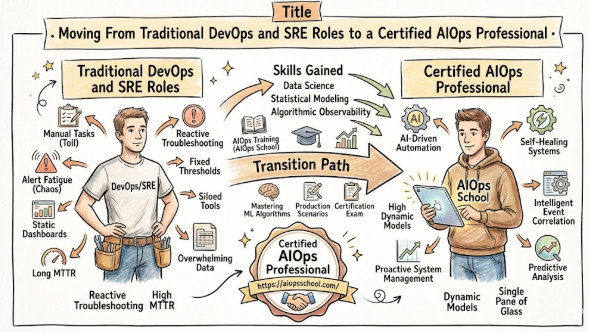
Unlike traditional infrastructure roles, this designation focuses heavily on the practical application of data science within real-world environments. It serves as a bridge connecting data engineering, automated deployment pipelines, and site reliability practices. Holding this certification demonstrates that you possess the hands-on engineering skills needed to design, deploy, and maintain self-healing cloud architectures.
Why it matters today?
Managing infrastructure by manually reacting to alerts is no longer sustainable. Engineering teams around the globe are suffering from acute alert fatigue, where critical system warnings are routinely buried under thousands of meaningless notifications. Systems are scaling up far faster than human teams can grow, creating an urgent operational gap that only intelligent automation can fill.
Organizations require modern engineers who can translate raw system data into predictive actions. Becoming certified matters because it shifts your operational mindset from reactive fire-fighting to proactive system management. By automating routine incident investigations, businesses can drastically lower their average time to repair failures, save significant capital, and let engineering teams focus on shipping features rather than managing downtime.
Why Certified AIOps Engineer certifications are important
Possessing a formal certification provides an undeniable advantage in a crowded job market. It offers a structured validation of your technical capabilities, making it instantly clear to hiring managers that you understand how to run modern production systems. It removes the guesswork from your resume by confirming your practical expertise in machine learning infrastructure and automated operations.
For experienced engineers, the certification provides a clear path to modernize an existing skill set. It forces you to get out of your comfort zone, pushing you to master complex concepts like event correlation, log parsing using algorithms, and automated remediation. This validation ensures you remain highly relevant and competitive as organizations transition away from legacy monitoring toward automated, data-driven observability.
Why choose AIOps School?
Choosing the right training platform determines how well you can apply these technical concepts in your daily work. AIOps School educational platform stands out because its entire curriculum is built around real-world application rather than dry, theoretical slides. Complex concepts are taught through intensive, hands-on cloud labs where actual production environments are built and managed from scratch.
The learning material is shaped directly by industry veterans who have managed large-scale production environments for decades. Every single learning track includes building public portfolios, receiving direct mentor feedback, and working through actual engineering failure scenarios. By choosing this platform, you gain access to a global network of tech professionals along with dedicated career placement support designed to help you succeed in the international job market.
3. Certification Deep-Dive
What is this certification?
This technical program is designed to validate an engineer's capability to deploy machine learning models directly into production infrastructure pipelines. It focuses heavily on hands-on tasks such as building automated anomaly detection, configuring intelligent log filtering, and setting up programmatic incident responses.
Who should take this certification?
This track is built specifically for working systems utilities engineers, platform specialists, cloud administrators, and technical operations leads who want to move into advanced automation roles.
Certification Overview Table
| Track | Level | Who it’s for | Prerequisites | Skills Covered | Recommended Order |
|---|---|---|---|---|---|
| AIOps Foundation | Foundational | Systems Admins, Fresh Grads, Tech Support | Basic Linux & Systems Operations knowledge | Data ingestion, telemetry basics, event noise reduction | First Step |
| AIOps Engineer | Intermediate | DevOps Engineers, SREs, Cloud Administrators | Core Python programming, basic monitoring awareness | Anomaly detection models, infrastructure tracking, auto-remediation | Second Step |
| AIOps Professional | Advanced | Senior Infrastructure Specialists, Tech Leads | 2+ years of hands-on deployment experience | Multi-cloud tracking, root cause analysis, compliance management | Third Step |
| AIOps Architect | Expert | Principal Architects, Infrastructure Directors | Deep platform design and enterprise infrastructure history | Reference architectures, scalability patterns, security governance | Fourth Step |
Skills you will gain
- Automated extraction of real-time metrics, system logs, and distributed traces across cloud environments.
- Configuration of mathematical anomaly detection algorithms to identify system performance degradation early.
- Implementation of advanced event correlation rules to eliminate alert fatigue across teams.
- Development of automated remediation scripts that fix known infrastructure issues without human intervention.
- Integration of predictive data analytics inside continuous deployment pipelines to manage autoscaling safely.
Real-world projects you should be able to do after this certification
- Intelligent Alerting Pipeline: Build an operational pipeline that filters out redundant system notifications and groups related alerts together based on structural log patterns.
- Self-Healing Infrastructure: Construct an automated response setup that detects memory leaks in containerized environments and restarts services gracefully without dropping user requests.
- Predictive Cloud Scaler: Design a machine learning utility that analyzes historical application usage data to scale up cloud resources before a traffic spike occurs.
Preparation plan
7–14 days plan
The foundational definitions and architectural layouts of intelligent operations should be studied during this initial phase. Time must be spent mastering basic Python data libraries and examining how structured system logs are parsed. The main focus should remain on understanding data ingestion paths and learning how to safely extract metrics from cloud platforms via standard APIs.
30 days plan
Active engagement with dedicated lab environments is required during this block of time. Production-grade data gathering tools must be configured to pipeline raw infrastructure metrics into central storage. Practical exercises should be completed to set up basic statistical baselines for application performance, allowing you to manually configure your first automated anomaly detection rules.
60 days plan
Advanced platform tuning and deep deployment tasks must be prioritized in the final weeks. Complex multi-service failure scenarios should be built in your sandbox to test how well your correlation rules operate under stress. Dedicate ample time to perfecting automated response scripts, running extensive open-book practice exams, and assembling your final portfolio projects for review.
Common mistakes to avoid
- Focusing purely on theoretical machine learning mathematics instead of focusing on practical infrastructure deployment skills.
- Neglecting to build a strong foundation in core software engineering skills like Python programming and API manipulation.
- Relying entirely on pre-built sandbox environments instead of provisioning your own production cloud resources from scratch.
- Failing to focus on clean log formatting, which is absolutely vital for training any operational machine learning model.
Best next certification after this
Same track
The advanced professional credential from the exact same provider should be pursued next to expand your technical authority over enterprise-grade automation strategies.
Cross-track
A dedicated machine learning operations deployment path is highly recommended to master the full lifecycle of training, serving, and versioning custom models at scale.
Leadership / management
An operations manager training certification should be evaluated next to learn how to calculate infrastructure investment returns and lead engineering teams through digital transformations.
Choose Your Learning Path
DevOps
This structured pathway is designed for engineers who want to integrate data-driven insights into continuous delivery pipelines. The focus is placed entirely on building intelligent gates that analyze deployment health automatically, allowing bad code rollouts to be stopped and reverted without human intervention.
DevSecOps
This specific learning path is tailored for professionals who wish to apply machine learning to security compliance and real-time threat detection. It details how to correlate security logs with standard infrastructure performance data to uncover hidden vulnerabilities and automate incident containment across cloud platforms.
Site Reliability Engineering (SRE)
This track is built for engineering specialists focused on maximizing system uptime and managing error budgets. The curriculum teaches how to move from traditional dashboards to predictive tracking systems, allowing potential service failures to be anticipated before they impact users.
AIOps / MLOps
This specialized route is intended for professionals who want to bridge the gap between data science and core systems engineering. It covers the end-to-end management of machine learning lifecycles, including data preparation, continuous model retraining, and live performance tracking.
DataOps
This learning path is designed for data specialists who manage complex pipeline architectures and storage warehouses. The training shows how to apply automated monitoring to data flows, ensuring high data quality, minimizing pipeline downtime, and tracking data lineage across the enterprise.
FinOps
This financial management pathway is structured for engineers who want to optimize cloud expenditures using intelligent automation. The lessons focus on identifying wasted resources algorithmically, forecasting infrastructure costs accurately, and automating budget alerts across multi-cloud environments.
5. Role → Recommended Certifications Mapping in table
| Role | Core Objective | Recommended Certification Pathway |
|---|---|---|
| DevOps Engineer | Automate deployment workflows safely | AIOps Engineer $\rightarrow$ MLOps Foundation |
| Site Reliability Engineer (SRE) | Maximize uptime and minimize manual toil | AIOps Engineer $\rightarrow$ AIOps Professional |
| Platform Engineer | Build internal infrastructure services | AIOps Engineer $\rightarrow$ AIOps Architect |
| Cloud Engineer | Manage multi-cloud architectures | AIOps Foundation $\rightarrow$ AIOps Engineer |
| Security Engineer | Automate real-time threat containment | DevSecOps Pathway $\rightarrow$ AIOps Engineer |
| Data Engineer | Maintain complex data pipeline health | DataOps Pathway $\rightarrow$ AIOps Foundation |
| FinOps Practitioner | Optimize enterprise cloud spending | FinOps Pathway $\rightarrow$ AIOps Foundation |
| Engineering Manager | Lead automated operations teams successfully | AIOps Manager $\rightarrow$ AIOps Professional |
Next Certifications to Take
One same-track certification
The advanced professional level certification within this operational track should be pursued next to deepen your mastery of enterprise architectures, real-time analytics tuning, and multi-cloud infrastructure strategy.
One cross-track certification
A dedicated machine learning operations deployment program should be selected to master model version control, automated retraining pipelines, and the scalable serving of custom data models in production.
One leadership-focused certification
An operations engineering management program should be evaluated next to develop long-term strategy design skills, team leadership methodologies, and professional frameworks for evaluating vendor technologies.
Training & Certification Support Institutions
DevOpsSchool
This global institution provides deep, instructor-led training programs focused entirely on modern software development and operations methodologies. Comprehensive study roadmaps, live deployment projects, and career counseling are delivered to students around the world.
Cotocus
This specialized training provider offers intensive, hands-on learning experiences designed to help cloud professionals update their technical skills. Their courses are built purely around production-grade lab exercises, ensuring engineers are fully prepared for enterprise challenges.
ScmGalaxy
This established community hub and educational center delivers high-quality learning resources focused on software configuration management and automated pipelines. Extensive study guides, video tutorials, and examination support are made accessible to working professionals.
BestDevOps
This technical educational platform focuses on delivering practical training tracks for modern platform engineering and infrastructure management. Step-by-step career mentorship is provided to assist engineers as they transition into advanced operations roles.
devsecopsschool.com
This learning portal is completely dedicated to teaching security integration within rapid deployment pipelines. Interactive tutorials and compliance-as-code labs are provided to help systems engineers master automated vulnerability tracking.
sreschool.com
This online educational platform provides targeted training focused purely on system reliability engineering principles and error budget management. Detailed learning pathways are delivered to teach professionals how to run large-scale cloud operations smoothly.
aiopsschool.com
This premier training platform delivers specialized education covering the intersection of data science and systems operations. Intensive lab tracks from foundational to architect levels are provided to help professionals master automated, self-healing infrastructure.
dataopsschool.com
This dedicated institution provides structured certification programs focused on the automation and quality management of enterprise data pipelines. Comprehensive courses are delivered to guide engineers in building reliable, high-throughput data systems.
finopsschool.com
This educational framework offers targeted training programs designed to help cloud professionals master infrastructure cost optimization. Practical lessons are provided on how to leverage automated monitoring tools to eliminate wasted cloud expenditure.
FAQs Section
General Career & Track Questions
What is the typical difficulty level of these automated operations certifications?
The introductory tracks are quite straightforward for anyone possessing basic systems operations knowledge, whereas the advanced engineer and architect levels require strong hands-on coding skills, configuration experience, and deep analytical problem-solving capabilities to pass successfully.
How much preparation time is generally required to complete the engineering track?
A dedicated commitment of roughly forty-five to sixty days is usually needed by a working professional, assuming an average of twelve to fifteen hours each week is spent practicing in labs and reviewing architectural documentation.
Are there any rigid technical prerequisites required before starting the foundation level?
No strict prerequisites are enforced for the initial foundational pathway, though a general understanding of cloud computing, basic command-line navigation, and common software development lifecycles will make the material much easier to grasp.
What is the most ideal sequence for taking these platform credentials?
The learning path should always be started with the foundational program, followed closely by the engineering certification, then moving into the advanced professional credential, and finally completing the track with the enterprise architect designation.
What direct career value does an automation certification provide to an engineer?
It offers a clear validation of your modernized skills, helping you stand out significantly for high-paying roles, transitioning your focus away from repetitive manual tasks, and opening up advanced engineering career opportunities.
Which specific job roles benefit the most from holding these credentials?
DevOps professionals, site reliability engineers, platform architects, cloud infrastructure specialists, systems administrators, and engineering managers all gain substantial value by integrating these automated methodologies into their teams.
Does this course curriculum require a deep background in advanced mathematics?
No, a deep understanding of complex data science mathematics is not required because the entire training program is focused on the practical implementation, configuration, and tracking of pre-built machine learning tools within cloud platforms.
Are these technical certification exams conducted completely online?
Yes, all the assessment tests are administered through a secure online platform, combining conceptual multiple-choice questions with practical, scenario-based lab assignments that must be solved within a set timeframe.
How long do these professional credentials remain valid after passing?
The industry certifications remain fully valid for a period of three years from the initial date of issue, after which standard continuing professional development paths can be completed to maintain your active status.
Can these credentials help reduce daily alert fatigue for engineering teams?
Yes, the core methodologies focus heavily on building automated event correlation and noise reduction pipelines, which successfully filters out unimportant notifications so engineers can focus on real infrastructure issues.
Is job placement assistance provided after completing the training track?
Comprehensive career support is delivered to all certified individuals, including professional resume reviews, interview preparation exercises, and direct access to global hiring partners looking for automated operations talent.
Can corporate teams enroll in customized versions of these training tracks?
Yes, tailored corporate training programs can be arranged to align perfectly with an organization’s specific infrastructure stack, complete with private mentor support and post-implementation consulting services.
Certified AIOps Engineer Specific FAQs
1. What is the primary goal of the Certified AIOps Engineer program?
The main purpose is to validate an engineer's practical capacity to deploy, tune, and manage intelligent automation tools directly inside live multi-cloud infrastructure environments.
2. How much programming knowledge is required for the Certified AIOps Engineer exam?
A comfortable, intermediate understanding of Python scripting is highly recommended, as you will need to develop automated data extraction tasks and connect infrastructure components via standard REST APIs.
3. What percentage of the engineering exam focuses on hands-on practical tasks?
The evaluation process splits focus evenly, allocating forty percent to conceptual understanding, forty percent to live scenario configuration in a lab cloud, and twenty percent to a final comprehensive project implementation.
4. Does the Certified AIOps Engineer curriculum cover cloud cost optimization?
Yes, fundamental principles of automated cost tracking and resource allocation are included, teaching you how to use algorithmic alerts to identify and eliminate underutilized cloud infrastructure automatically.
5. How does this engineering certification connect with traditional SRE practices?
It acts as an expansion of site reliability principles by replacing manual incident analysis with predictive machine learning models, allowing error budget consumption to be anticipated before service degradation occurs.
6. What open-source tools are covered in the Certified AIOps Engineer labs?
Extensive hands-on practice is provided using industry-standard telemetry collectors, open-source log parsers, statistical analysis utilities, and popular model tracking dashboards commonly used in production environments.
7. Is a dedicated hardware setup needed to complete the engineering course labs?
No dedicated local hardware is required because all practical exercises and project assignments are performed inside fully isolated, cloud-based learning environments provided directly by the platform.
8. Can a traditional software engineer transition into infrastructure roles via this program?
Yes, the systematic layout of the engineering track provides a clear bridge for developers, teaching them how to apply their existing coding skills to solve complex infrastructure automation challenges.
Testimonials
Rajesh
The cloud analytics training provided me with an incredibly clear roadmap for updating my infrastructure skill set. Building real-world log correlation pipelines in the practical labs gave me the exact technical capabilities I needed to step confidently into a modern platform automation role.
Ananya
Alert noise has dropped significantly across our production clusters since our team began implementing these intelligent response methodologies. The step-by-step training helped me understand how to parse unstructured logs algorithmically, providing immediate stability benefits to our live microservices.
Vikram
Career progression had stalled while managing standard deployment pipelines day after day using legacy monitoring tools. Completing this specialized engineering track allowed me to modernize my profile, resulting in a smooth transition toward a high-impact infrastructure optimization role.
Priya
My overall confidence regarding system observability has grown tremendously after completing the comprehensive portfolio projects. I am now fully capable of designing self-healing container setups that automatically catch performance anomalies before they impact our global user base.
Rohan
Leading a modern engineering squad requires a deep, practical understanding of where automation genuinely helps versus where simple alerts suffice. This educational track delivered the precise strategic insights and metrics needed to successfully guide our enterprise digital transformation.
Conclusion
Upgrading your technical capabilities through a structured pathway is the most efficient way to stay ahead in the rapidly shifting cloud infrastructure market. The transition away from manual, reactive operations toward proactive, self-healing architectures is happening across every major industry sector globally. Acquiring a recognized certification ensures your technical validation matches the urgent operational needs of modern enterprise environments.
Investing time into mastering automated anomaly detection, event correlation, and data-driven infrastructure management pays massive long-term career dividends. It elevates your professional standing from a standard engineer to a critical strategic asset capable of managing systems at massive scale. Plan your learning path systematically, utilize dedicated lab environments fully, and position your career at the absolute forefront of modern digital operations.



Top comments (0)