
Introduction
DevOps is widely recognized as one of the most rewarding career paths in the IT industry. As organizations transition to digital-first models, the demand for professionals who can bridge the gap between development and operations has surged. This rise in demand is directly linked to the massive global adoption of cloud computing, automated infrastructure, and container orchestration.
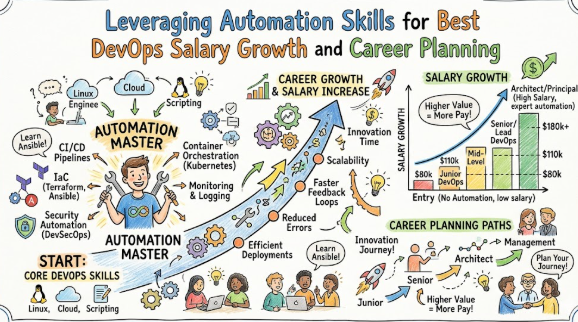
DevOps salaries are steadily increasing because businesses face a chronic shortage of skilled talent capable of managing complex, high-scale environments. It is not just about holding certifications; true salary growth is driven by the ability to solve real-world problems, enhance system reliability, and reduce operational costs. This guide helps you navigate the landscape of DevOps compensation, career roadmaps, and the specializations that command the highest rewards.
Why DevOps Salaries Are High
The compensation for DevOps roles remains competitive due to several fundamental shifts in the IT landscape:
- Cloud Adoption: Companies are moving away from on-premise hardware to multi-cloud and hybrid environments, requiring experts to manage these migrations.
- Automation: The necessity to replace manual processes with automated CI/CD pipelines has made automation skills critical for maintaining business velocity.
- Containerization: The widespread adoption of Kubernetes and Docker requires specialized knowledge to manage distributed application lifecycles.
- Security Integration: The rise of DevSecOps ensures that security is woven into the development lifecycle, increasing the value of professionals who understand both operations and security.
- Talent Scarcity: There is a significant gap between the number of available positions and professionals with verified experience in complex infrastructure management.
Who Should Read This Guide
This guide is designed for individuals looking to understand the financial trajectory of a DevOps career, including:
- Freshers looking to break into the industry
- Developers transitioning into infrastructure-focused roles
- Linux administrators expanding into cloud environments
- Automation and SRE engineers
- Platform and DevSecOps professionals
- IT professionals seeking a career change
DevOps Salary Overview
Salary trends in DevOps are dynamic and generally track with business impact. Professionals who tie their work directly to revenue uptime, regulatory compliance, or gross margin optimization (such as managing cloud costs) typically see higher compensation ceilings.
While entry-level roles focus on executing specific pipeline or infrastructure tasks, mid-level and senior roles are defined by system design, mentorship, and incident leadership. The industry is currently seeing a bifurcation in pay markets: high-scale product organizations often offer equity-heavy packages, while regulated enterprises prioritize bonus structures.
DevOps Salary by Experience Level
| Experience Level | Typical Roles | Skills Expected | Salary Growth Potential | Career Scope |
|---|---|---|---|---|
| Fresher | Junior DevOps Engineer | Linux, Git, Scripting | Entry-level baseline | Foundation building |
| Mid-Level | DevOps Engineer | CI/CD, Terraform, Cloud | Moderate to High | System ownership |
| Senior | Senior DevOps Engineer | Kubernetes, Architecture | High | Design & Mentorship |
| Lead / Architect | Platform / Lead Engineer | Strategy, Observability | Very High | Org-wide direction |
Highest Paying DevOps Roles
Roles that involve platform ownership or security enablement often command premium compensation compared to general baseline roles.
| Role | Main Skills | Difficulty Level | Salary Potential | Career Demand |
|---|---|---|---|---|
| DevOps Engineer | CI/CD, Infra Automation | Moderate | Baseline | High |
| SRE Engineer | SLOs, Incident Response | High | +0–15% | Very High |
| Platform Engineer | Internal Developer Platforms | High | +5–20% | High |
| DevSecOps Engineer | Security-as-Code | High | +10–30% | Very High |
DevOps Salary by Skills
Salary potential is highly correlated with specialized skill sets. Foundational knowledge in Linux and Git is essential, but high-paying opportunities emerge from mastery in:
- Infrastructure as Code (IaC): Tools like Terraform are essential for scaling.
- Containerization: Deep expertise in Kubernetes is a primary driver for senior-level pay.
- Observability: Knowledge of logging, metrics, and tracing to maintain system reliability.
- FinOps: Understanding cloud unit costs and capacity economics is increasingly valuable to management.
DevOps Salary by Certification
Certifications serve as a benchmark for foundational knowledge, though they should be paired with practical project experience to maximize salary impact.
| Certification | Best For | Career Level | Skills Covered | Salary Impact |
|---|---|---|---|---|
| Available Credentials | Cloud/Orchestration | Entry to Senior | Varies by Provider | Increases visibility |
DevOps Salary by Country or Region
Compensation varies significantly based on regional economic factors and the maturity of the local tech market. Countries with high demand for cloud-native infrastructure typically show higher median salaries. Product-based companies generally offer more competitive packages than traditional service-based organizations, and remote roles are increasingly subject to geo-based compensation bands.
DevOps Salary by Company Type
- Startups: Often offer broader learning exposure and potential equity, though base salaries may vary depending on funding.
- Product Companies: Tend to pay higher base salaries and offer structured growth ladders.
- MNCs / Enterprise: Typically provide stability and bonus structures but may have more rigid, tiered hierarchies.
- Service-based Companies: Often focus on rate-card driven compensation, which may differ from the product-focused salary model.
Factors That Affect DevOps Salary
Your compensation is generally influenced by:
- Infrastructure Scale: Experience managing high-traffic, multi-region systems.
- Decision Authority: Being able to design systems rather than just executing tasks.
- Specialization: Focusing on high-demand areas like DevSecOps or SRE.
- Communication: The ability to explain technical strategy to non-technical stakeholders.
Best Skills for High DevOps Salary
A structured approach to skill acquisition is the most reliable way to increase your market value:
- Beginner: Linux, Git, Networking, Shell Scripting.
- Intermediate: Docker, Jenkins, Terraform, CI/CD.
- Advanced: Kubernetes, Cloud Architecture, GitOps, Observability, DevSecOps.
Real-World Career Scenarios
- Developer to DevOps: Leveraging existing coding skills to automate infrastructure creates a niche profile that is highly sought after.
- System Admin to Cloud DevOps: Transitioning from traditional server management to cloud-native platforms allows for a significant increase in role scope.
- SRE Growth: Moving into reliability engineering by focusing on SLOs and toil reduction directly translates into higher compensation.
Common Mistakes That Reduce Salary Growth
- Focusing solely on tools without understanding the underlying business problems.
- Neglecting Linux basics or cloud fundamentals.
- Avoiding Kubernetes or complex orchestration projects.
- Failing to maintain a professional portfolio on GitHub.
- Lacking a clear strategy for automation and reliability.
Hands-On Projects to Increase Salary Opportunities
To increase your value, work on projects that demonstrate:
- Building end-to-end CI/CD pipelines.
- Executing secure deployments using DevSecOps practices.
- Multi-cloud infrastructure automation.
- Establishing monitoring and alerting systems for real-world applications.
Career Roadmap for Better Salary Growth
- Beginner Path: Linux → Git → Docker → CI/CD.
- Intermediate Path: Terraform → Jenkins → Cloud Fundamentals.
- Advanced Path: Kubernetes → Cloud Architecture → DevSecOps → Platform Engineering.
FAQs
Is DevOps a high-paying career?
Yes, because DevOps roles are critical to business uptime and operational efficiency, they are among the highest-paid positions in IT.
Which DevOps skill gives the highest salary?
Skills that tie directly to reliability and security—such as Kubernetes, SRE, and DevSecOps—consistently command premium rates.
Is Kubernetes good for salary growth?
Yes, it is the standard for modern container orchestration, and expertise in this area is highly valued in the current market.
Does certification increase salary?
Certifications validate knowledge, but they are most effective when coupled with hands-on experience and the ability to solve complex infrastructure problems.
Is DevOps better than software development?
It is not about which is "better," but rather different paths. DevOps focuses on the infrastructure and lifecycle of software, offering distinct challenges and growth opportunities.
How long does it take to become a DevOps engineer?
It depends on your background. Professionals with a foundation in Linux or development can transition by focusing on the core DevOps roadmap through dedicated project work.
Final Recommendation
To achieve long-term success, focus on gaining deep, hands-on experience rather than collecting certificates. Prioritize learning cloud platforms and Kubernetes, as these are the cornerstones of modern infrastructure. Always look for ways to tie your work to measurable operational outcomes, such as cost reduction, improved reliability, or increased deployment frequency. Continuous learning is not optional in this field; it is the primary requirement for sustained salary growth and career advancement.



Top comments (0)