
Introduction
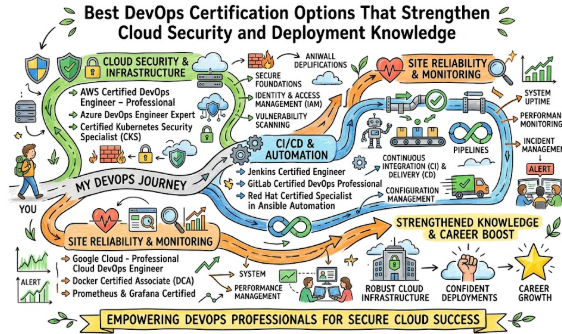
In today’s fast-paced software development landscape, the ability to bridge the gap between development and operations is a superpower. As organizations shift toward cloud-native architectures, automation, and continuous delivery, the demand for skilled professionals has skyrocketed. Navigating the maze of certifications can be overwhelming, with options spanning Kubernetes, cloud platforms, security, and machine learning. Pursuing the Best DevOps Certification not only validates your expertise but provides a structured roadmap to mastering modern engineering practices. Whether you are a fresher aiming for your first role or a seasoned engineer looking to specialize in SRE or DevSecOps, understanding which credential aligns with your career trajectory is the first step toward professional growth.
What is a DevOps Certification?
A Best DevOps certification is more than just a badge on your profile; it is a formal recognition of your proficiency in the principles, tools, and methodologies that enable high-velocity software delivery. It validates your ability to manage complex infrastructures, implement CI/CD pipelines, ensure system reliability, and secure cloud environments. By opting for a structured certification program, you move beyond theoretical knowledge and engage in hands-on practice, learning how to integrate disparate tools into a cohesive, automated system. It essentially serves as a verified benchmark of your readiness to handle the operational challenges of modern software lifecycles.
Why DevOps Certifications Matter
Certifications serve as a vital differentiator in a crowded job market. They demonstrate a commitment to continuous learning and provide employers with confidence that you possess the necessary technical toolkit.
- Skill Validation: They prove you have mastered specific technologies like Kubernetes, Terraform, or cloud-native services.
- Industry Standardized Knowledge: You learn industry-best practices rather than relying solely on trial-and-error.
- Enhanced Career Prospects: Certified professionals often command higher salaries and are frequently prioritized for complex, high-impact projects.
- Networking Opportunities: Many certification communities provide access to experts and peers, fostering knowledge sharing.
Step-by-Step Process:
- Assess Your Goals: Determine if you want to be a generalist DevOps Engineer, a security specialist, or a data-focused MLOps engineer.
- Choose a Certification: Select a path that matches your current skill level (beginner to advanced).
- Engage in Labs: Use hands-on labs to practice CLI commands, infrastructure automation, and troubleshooting.
- Prepare for the Exam: Use official documentation and practice tests.
- Apply and Certify: Take the assessment to earn your credentials and update your professional profile.
Who Should Take DevOps Certifications?
The DevOps ecosystem is broad, making these certifications relevant for a wide range of professionals, including:
- Software Engineers: Developers looking to understand how their code is deployed and scaled.
- System Administrators: Professionals transitioning from traditional infrastructure management to Cloud/SRE roles.
- Cloud Engineers: Those managing multi-cloud environments (AWS, Azure, GCP).
- Security Professionals: Experts aiming to integrate security into DevOps pipelines (DevSecOps).
- Data/ML Engineers: Technical staff looking to automate the lifecycle of machine learning models (MLOps).
- IT Managers: Leaders who need a high-level understanding of DevOps principles to guide their teams.
Core Skills Covered
Professional DevOps certification programs generally focus on building a versatile technical foundation:
- Continuous Integration/Continuous Deployment (CI/CD): Understanding how to automate code testing, integration, and deployment to production environments.
- Infrastructure as Code (IaC): Using tools like Terraform or CloudFormation to provision and manage infrastructure declaratively.
- Containerization & Orchestration: Mastering Docker for packaging and Kubernetes for orchestrating containerized applications at scale.
- Cloud Platforms: Navigating AWS, Azure, or GCP services to build scalable and cost-effective cloud architectures.
- Monitoring & Observability: Utilizing tools like Prometheus and Grafana to track system health and performance.
Table 1: Best DevOps Certifications
| Certification Name | Best For | Skill Level | Career Direction |
|---|---|---|---|
| DevOps Certified Professional (DCP) | Foundations | Beginner | DevOps Engineer |
| DevSecOps Certified Professional (DSOCP) | Security Focus | Intermediate | DevSecOps Engineer |
| Site Reliability Engineering (SRE) Certified Professional | Reliability | Intermediate | SRE |
| Master in DevOps Engineering (MDE) | Advanced Ops | Advanced | DevOps Architect |
| Master in Azure DevOps | Microsoft Cloud | Intermediate | Azure Specialist |
| AWS Certified DevOps Professional | AWS Cloud | Advanced | AWS Expert |
| Master in Python Programming | Scripting | Beginner | Automation Eng |
| Hashicorp Certified Terraform Associate | Infrastructure | Intermediate | IaC Specialist |
| Certified Kubernetes Administrator (CKA) | Orchestration | Advanced | K8s Administrator |
| Docker Certified Associate (DCA) | Containerization | Intermediate | Platform Eng |
| Envoy ISTIO Certification Training | Service Mesh | Advanced | Network Engineer |
| MLOps Certification Training Course | AI/ML Ops | Advanced | MLOps Engineer |
| Google Cloud Professional Cloud DevOps Engineer | Google Cloud | Advanced | GCP Engineer |
| Master in Machine Learning | Data/AI | Intermediate | ML Engineer |
| Master in Artificial Intelligence | AI Theory | Advanced | AI Researcher |
| Master in AppDynamics | Monitoring | Intermediate | Observability Eng |
| Master in Data Science | Analytics | Intermediate | Data Engineer |
| Master in Deep Learning | Neural Networks | Advanced | DL Specialist |
| Prometheus with Grafana | Observability | Beginner | Systems Monitor |
| GitOps Certified Professional (GOCP) | Git Workflows | Intermediate | GitOps Engineer |
Certification Deep Dive
Real-World Use Case
Imagine a global e-commerce platform that needs to release updates daily without downtime. A professional with the right certification implements a CI/CD pipeline using Terraform for IaC and Kubernetes for scaling, ensuring that every code commit is automatically tested, scanned for security vulnerabilities, and deployed seamlessly.
Skills You Will Learn
You will acquire proficiency in version control (Git), infrastructure provisioning, container runtime management, automated security scanning, and distributed system monitoring.
Career Scope
The market for these skills is global and growing. You can aim for roles ranging from Junior DevOps Engineer to Cloud Architect, Site Reliability Engineer, or specialized positions in MLOps and DevSecOps.
Difficulty Level
Certifications range from foundational (Beginner) for those starting out, to expert-level (Advanced) for those managing enterprise-scale production systems.
Best Career Fit/Who Should Take It
Ideal for individuals who enjoy problem-solving, automation, and working in high-availability environments where software quality and speed are paramount.
Hands-On Projects
Most programs involve creating functional pipelines, deploying a multi-tier application on Kubernetes, writing infrastructure code, and setting up automated monitoring alerts for production systems.
DevOps Certification Roadmap
| Career Goal | Recommended Certification Path | Why It Fits |
|---|---|---|
| Foundation | DCP + Python | Builds essential ops knowledge and scripting skills. |
| Cloud Specialist | AWS or Azure Master | Targets specific platform-level expertise. |
| Reliability/SRE | SRE + CKA + Prometheus | Focuses on system uptime, scaling, and observability. |
| Security/DevSecOps | DSOCP + CKA | Integrates security into the Kubernetes stack. |
| AI/ML Infrastructure | MLOps + Data Science | Bridges the gap between ML models and ops. |
Types of DevOps Certifications
Certifications are generally categorized by their focus area:
- Platform-Specific: Focus on vendor ecosystems like AWS, Azure, or GCP.
- Tool-Specific: Focus on a single core technology like Kubernetes (CKA), Docker (DCA), or Terraform.
- Role-Based: Focus on methodology and career roles, such as SRE or DevSecOps.
Certification Path by Role
- For Beginners: Start with Python and DevOps Certified Professional (DCP).
- For Intermediate Engineers: Pursue Terraform, Docker, and Cloud-specific certifications.
- For Experts: Specialize in advanced Kubernetes, MLOps, or large-scale observability like Istio and Prometheus.
Common Mistakes to Avoid
- Over-certifying: Accumulating too many certifications without building actual projects.
- Neglecting Theory: Focusing only on tools and ignoring fundamental DevOps principles.
- Ignoring Hands-on: Expecting a badge alone to land a job without practical lab experience.
- Focusing on one tool: Failing to diversify skills across the entire lifecycle (Dev -> Security -> Ops).
5 Real-Life Examples
- Automated Scaling: A startup uses Kubernetes and Terraform to handle sudden traffic spikes on Black Friday, ensuring zero downtime.
- Security Compliance: A bank implements DevSecOps, using automated scanning to ensure code meets security standards before it reaches production.
- ML Pipelines: An AI company uses MLOps to retrain and deploy predictive models automatically as new data enters the system.
- Reliability Monitoring: An SRE uses Prometheus and Grafana to detect system degradation, allowing the team to fix issues before customers are affected.
- Infrastructure Efficiency: A global enterprise migrates to IaC, reducing server provisioning time from weeks to minutes.
FAQs
Q: Do I need programming skills to start in DevOps?
A: Yes, basic scripting skills in languages like Python or Bash are essential for automating tasks and managing infrastructure efficiently.
Q: Which certification should I start with?
A: The DevOps Certified Professional (DCP) is the best starting point to build a strong foundation in core methodologies and toolsets.
Q: How long does it take to get certified?
A: Depending on your experience, it typically takes 4 to 12 weeks of consistent study and hands-on practice to prepare for most professional certifications.
Q: Does experience matter more than certifications?
A: Both are important. Certifications provide the structural knowledge, while experience validates your ability to apply that knowledge in real-world scenarios.
Q: Is Kubernetes necessary for every DevOps role?
A: In modern cloud-native environments, Kubernetes is highly prevalent, and having CKA-level knowledge significantly boosts your employability.
Q: Are these certifications recognized globally?
A: Yes, industry-standard certifications like CKA, AWS, and expert-led programs are globally recognized by top-tier tech firms.
Q: Can I take these courses if I am currently a developer?
A: Absolutely. Devs who understand DevOps principles (the "Dev" in DevOps) are often the most effective at designing scalable and robust software.
Q: How do I choose between AWS and Azure DevOps certifications?
A: Choose based on the primary cloud provider your target company uses or the one you are most interested in mastering first.
Q: What is the difference between DevOps and SRE?
A: DevOps is a cultural and operational philosophy, while SRE is a specific engineering-based approach to implementing that philosophy with a focus on reliability.
Q: Do these certifications expire?
A: Most certifications have a validity period (usually 2–3 years) and require recertification to ensure your skills remain updated with the latest technological trends.
Q: How can I gain hands-on experience without a job?
A: Use cloud free tiers, build personal projects on GitHub, and practice in virtual lab environments provided by your certification training.
Conclusion
Embarking on a DevOps career path requires a strategic, step-by-step approach. By combining foundational knowledge with advanced tool-specific certifications, you build a powerful portfolio that demonstrates both your breadth of understanding and depth of expertise. Always prioritize hands-on practice—building, breaking, and fixing systems is the surest way to internalize complex concepts.



Top comments (0)