
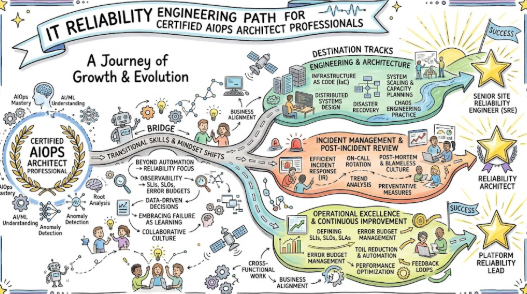
Introduction
Modern IT infrastructure has grown too complex for human teams to manage alone. With thousands of microservices running across multi-cloud environments, billions of logs, metrics, and traces are generated every single second. Traditional monitoring setups rely on manual thresholds, which constantly triggers alert fatigue and causes prolonged downtime. To solve this operational bottleneck, Artificial Intelligence for IT Operations (AIOps) is being rapidly adopted by enterprises worldwide.
A deep understanding of how to combine AI, machine learning, and automation with traditional operations is now required for senior engineering roles. This comprehensive guide details everything that is needed to understand the Certified AIOps Architect program, its structure, and how career trajectories can be transformed by this advanced credential in both Indian and global tech markets.
What is Certified AIOps Architect
The Certified AIOps Architect is an expert-level professional credential designed for senior engineers and technical leaders who are responsible for designing large-scale, intelligent infrastructure systems. This certification validates the capability to build automated, self-healing platforms that leverage machine learning algorithms to predict, detect, and remediate infrastructure failures before business operations are impacted.
Unlike basic certifications that focus only on using specific software tools, this program focuses deeply on enterprise-grade system design, multi-cloud scalability, and the architectural frameworks needed to ingest and analyze petabyte-scale operational telemetry.
Why it matters today?
As systems grow exponentially, human cognitive capacity is easily outpaced by the sheer volume of operational noise. Traditional operations are reactive, meaning fixes are only applied after a breakdown occurs. Today, businesses demand proactive availability, minimal mean time to resolution (MTTR), and optimized cloud costs.
AIOps closes this gap by transforming raw infrastructure data into actionable insights through automated anomaly detection and predictive correlation. Possessing architecture-level knowledge in this domain is highly valued by global organizations as they move away from legacy monitoring and transition toward autonomous, intelligent infrastructure operations.
Why Certified AIOps Architect certifications are important
Earning an advanced validation in AIOps architecture provides substantial competitive advantages in the modern enterprise landscape:
- Validation of Strategic Design Skills: Expertise in architecting operational data lakes and complex machine learning pipelines is formally validated.
- Drastic Noise Reduction: Organizations are helped by certified professionals to eliminate up to 90% of alert fatigue through intelligent alert correlation.
- Career Advancement: Traditional operations and DevOps roles are elevated into high-demand architecture and leadership positions.
- Global Market Value: Highly competitive compensation packages and senior roles are easily commanded across India, the US, and European markets.
Why choose AIOps School?
AIOps School is widely recognized as the premier educational platform dedicated exclusively to AI-driven IT operations and machine learning lifecycle management. The curriculum is created entirely by active industry practitioners who manage complex production environments daily.
Rather than relying purely on theoretical textbooks, learning is driven by hands-on labs, real-world architecture blueprints, and rigorous design challenges. Programs from this platform are trusted globally, helping professionals across more than 50 countries secure measurable salary growth and elite roles at top-tier technology companies.
Certification Deep-Dive
What is this certification?
The Certified AIOps Architect is the highest-level credential in the hierarchy, proving mastery in defining reference architectures, building self-service observability platforms, and leading enterprise-wide operational transformations.
Who should take this certification?
This program is specifically designed for Principal Engineers, Enterprise Architects, Senior DevOps Managers, Site Reliability Engineering (SRE) Leaders, and Technical Directors who oversee cloud-native infrastructure strategy.
Certification Overview Table
| Track | Level | Who it’s for | Prerequisites | Skills Covered | Recommended Order |
|---|---|---|---|---|---|
| AIOps Foundation | Beginner | Junior Engineers, Helpdesk Techs | Basic IT Operations | Data Collection, Alert Noise Reduction, ML Basics | 1st |
| Certified AIOps Engineer | Intermediate | DevOps Engineers, SREs | Foundational AIOps | Anomaly Detection Models, Auto-Remediation | 2nd |
| Certified AIOps Professional | Advanced | Team Leads, Cloud Architects | Engineering Level | Tool Selection, Strategy, ROI Optimization | 3rd |
| Certified AIOps Architect | Expert | Principal Architects, Directors | Professional Level | Reference Architectures, Petabyte Scalability | 4th |
Skills you will gain
- Designing comprehensive enterprise-wide AIOps reference architectures.
- Building internal self-service platforms that provide automated observability to hundreds of development teams.
- Architecting distributed operational data lakes that unify high-volume logs, metrics, traces, and events.
- Implementing advanced partitioning and ingestion patterns to process petabyte-scale telemetry with sub-second latency.
- Structuring zero-trust security compliance and robust governance frameworks for automated remediation scripts.
Real-world projects you should be able to do after this certification
- Design and deploy an internal self-service platform offering automated anomaly detection for microservices.
- Build a centralized, multi-cloud operational data lake that handles massive daily data ingestion using open-source telemetry standards.
- Create an automated root-cause analysis workflow that cross-correlates infrastructure events with application deployment logs to instantly pinpoint faults.
- Architect a closed-loop auto-remediation system that safely fixes specific container failure loops without human intervention.
Preparation plan
7–14 days plan
- The entire official syllabus and exam blueprint must be reviewed thoroughly.
- Core concepts regarding enterprise architecture frameworks and multi-cloud ingestion patterns should be studied.
- Official documentation and reference architecture templates provided by the portal must be analyzed.
30 days plan
- Deep-dive studies into operational data lake designs and data partitioning strategies should be completed.
- Hands-on lab environments must be utilized to build prototype telemetry collection topologies.
- Sample architecture design challenges should be practiced to master structural decision-making logic.
60 days plan
- Advanced scenarios regarding automated remediation safety and compliance governance must be thoroughly covered.
- Full-length practice exams should be taken under realistic timed conditions to improve speed and confidence.
- The final architecture presentation portfolio must be refined and submitted for final evaluation.
Common mistakes to avoid
- Focusing purely on specific vendor tool configurations instead of mastering universal architectural principles.
- Neglecting data governance and zero-trust security rules when designing automated infrastructure remediation systems.
- Underestimating the strict timing constraints and high rubrics of the production-level architecture design challenge.
- Failing to connect infrastructure engineering metrics directly to high-level business outcomes and cost ROI.
Best next certification after this
Same track
- Advanced specialization modules covering deep learning for automated system root-cause diagnosis.
Cross-track
- Certified MLOps Architect to master the lifecycle management and deployment architectures of complex enterprise machine learning models.
Leadership / management
- Certified AIOps Manager to transition technical architectural mastery into corporate strategy, vendor negotiation, and large-scale team building.
Choose Your Learning Path
DevOps Path
This path is customized for cloud engineers focused on continuous delivery. Continuous deployment monitoring is enhanced by embedding automated anomaly detection directly into the delivery pipeline, allowing faulty releases to be rolled back using intelligent telemetry signals.
DevSecOps Path
This path is structured for security-focused infrastructure specialists. Advanced machine learning algorithms are utilized to scan compliance logs, analyze access patterns in real-time, and automatically isolate compromised resources before threats spread across the network.
Site Reliability Engineering (SRE) Path
This path is designed specifically for professionals focused on system availability. Traditional static alert thresholds are replaced with dynamic, machine-learned service level objectives (SLOs), drastically decreasing alert noise and dramatically accelerating MTTR.
AIOps / MLOps Path
This path is optimized for platform engineers building data systems. Seamless infrastructure support is provided for training, testing, and serving enterprise machine learning models at massive scale while ensuring optimal underlying resource utilization.
DataOps Path
This path is built for data pipeline and data warehouse architects. Continuous automated quality checks, distributed lineage tracking, and proactive performance tuning are integrated into massive data orchestration streams to prevent pipeline failures.
FinOps Path
This path is designed for professional cloud financial managers. Machine learning models are applied to complex infrastructure usage patterns to predict cloud spend anomalies, automate waste elimination, and dynamically allocate cluster resources for peak efficiency.
Role → Recommended Certifications Mapping
| Current Role | Target Goal | Primary Certification | Secondary Certification |
|---|---|---|---|
| DevOps Engineer | Intelligent Automation Specialist | Certified AIOps Engineer | Certified MLOps Engineer |
| Site Reliability Engineer | Autonomous Infrastructure Lead | Certified AIOps Architect | Certified MLOps Professional |
| Platform Engineer | Internal Observability Architect | Certified AIOps Architect | Certified MLOps Architect |
| Cloud Engineer | Next-Gen Cloud Infrastructure Lead | Certified AIOps Professional | Certified MLOps Foundation |
| Security Engineer | Autonomous DevSecOps Lead | Certified AIOps Engineer | Certified MLOps Professional |
| Data Engineer | Automated Data Pipeline Architect | Certified AIOps Architect | Certified MLOps Engineer |
| FinOps Practitioner | Predictive Cloud Cost Architect | Certified AIOps Professional | Certified MLOps Foundation |
| Engineering Manager | Strategic Technology Director | Certified AIOps Manager | Certified MLOps Manager |
Next Certifications to Take
One same-track certification
The Certified AIOps Manager credential can be pursued to effectively translate deep technical system architecture blueprints into clear corporate strategies, business value metrics, and long-term organizational transformation roadmaps.
One cross-track certification
The Certified MLOps Architect certification can be undertaken to fully master the end-to-end infrastructure pipeline needed for training, deploying, and governing production-grade machine learning models across complex multi-cloud environments.
One leadership-focused certification
An executive IT infrastructure leadership certification can be targeted to acquire specialized skills in high-level vendor evaluation, multi-million dollar budget management, and the organizational change management required for modern enterprise expansion.
Training & Certification Support Institutions
DevOpsSchool
Comprehensive, instructor-led training programs are delivered by this platform, focusing deeply on foundational and advanced cloud-native infrastructure automation methodologies. Extensive hands-on practice labs are provided to ensure engineering teams gain production-ready skills quickly.
Cotocus
Specialized corporate consulting and deep technical workforce upskilling services are offered globally by this organization. Technical teams are guided through highly structured modern training pathways designed to smoothly transition traditional legacy IT operations into automated cloud environments.
ScmGalaxy
An extensive, knowledge-rich resource portal and community network is maintained by this institution for software configuration and deployment professionals. Practical tutorials, deep technical blogs, and regular workshops are organized to keep engineers updated on modern orchestration tools.
BestDevOps
Focused learning roadmaps and step-by-step technical educational materials are curated by this site for aspiring platform engineers. Core infrastructure concepts are broken down into digestible modules, making complex deployment methodologies highly accessible to growing professionals.
devsecopsschool.com
Educational programs entirely dedicated to embedding modern security practices directly into the automated delivery lifecycle are hosted here. Secure coding, automated vulnerability scanning, and continuous infrastructure compliance techniques are thoroughly taught to engineering cohorts.
sreschool.com
Elite training tracks designed specifically for system reliability, high availability, and advanced site reliability engineering methodologies are delivered on this site. Production telemetry monitoring, incident management, and complex post-mortem strategies are analyzed in depth.
aiopsschool.com
The premier educational platform for mastering artificial intelligence applications within modern IT operations is hosted on this portal. Globally recognized certifications and intensive project labs are offered from foundational levels up to enterprise architect mastery.
dataopsschool.com
Structured certification programs and specialized curriculum covering agile data management are provided by this online platform. Building, testing, and maintaining automated data pipelines with high reliability and zero data loss are deeply emphasized.
finopsschool.com
Educational resources focused explicitly on cloud financial management and architecture optimization are delivered through this site. Cloud cost visibility, automated budgeting, and collaborative resource engineering techniques are thoroughly taught to cloud financial managers.
FAQs Section
General Certification FAQs
Q1: What is the overall difficulty level of the advanced certification exams?
The exams are considered highly challenging because they evaluate strategic system design alongside practical engineering knowledge instead of simple definition memorization.
Q2: How much time is typically required to prepare for an expert certification?
A minimum of 40 to 60 dedicated hours spread over one to two months is generally needed, depending heavily on prior hands-on production experience.
Q3: Are there strict technical prerequisites before taking the expert exam?
Yes, a solid understanding of cloud-native concepts, basic container orchestration, and foundational infrastructure monitoring principles is highly recommended before enrolling.
Q4: What is the recommended certification sequence for an absolute beginner?
Starting with the Foundation level is advised, followed sequentially by the Engineer track, the Professional level, and finally the Architect exam.
Q5: What long-term career value does this certification track offer to engineers?
Professionals are transformed from reactive troubleshooters into proactive system designers, leading to highly accelerated promotion cycles and executive technical recognition.
Q6: Which specific job roles can be targeted after completing the training?
Senior roles such as Enterprise Cloud Architect, Platform Engineering Director, Principal SRE, and Autonomous Operations Lead can be successfully targeted.
Q7: How does this program help in securing higher compensation packages?
A rare, highly specialized skill set combining data science with system operations is validated, allowing top-tier compensation packages to be commanded globally.
Q8: Is global industry recognition provided upon passing the official exam?
Yes, digital badges and certificates are issued that are widely trusted and verified by major enterprise tech employers globally.
Q9: How are the examinations conducted and evaluated by the provider?
Exams are administered online through secure, proctored platforms consisting of multiple-choice questions along with complex scenario-based design challenges.
Q10: What is the validity period of the professional certificate?
The credential remains officially valid for a period of three years, after which simple renewal paths or advanced continuing education modules are offered.
Q11: Are hands-on practical lab exercises included in the training packages?
Yes, comprehensive sandbox environments and real-world project labs are integrated into the preparation curriculum to build genuine engineering skills.
Q12: Can traditional software development managers benefit from this track?
Yes, critical strategic insights regarding infrastructure scalability, modern tool selection, and engineering ROI are gained by engineering managers.
Certified AIOps Architect FAQs
Q1: What unique topics are covered under the Certified AIOps Architect exam?
Deep architectural topics including multi-cloud reference architectures, petabyte-scale telemetry ingestion, and operational data lake design patterns are covered.
Q2: What is the exact format and duration of the Architect examination?
The examination is three hours long and consists of 60 advanced multiple-choice questions combined with a comprehensive practical Architecture Design Challenge.
Q3: What is the passing score requirement for the official Architect certification?
A minimum passing score of 78% must be achieved on the combined sections to be awarded the official gold-tier digital architect badge.
Q4: How does the Architect credential differ from the Certified AIOps Engineer track?
The Engineer track focuses purely on implementing anomaly models and tools, whereas the Architect level focuses on designing the entire enterprise-wide platform.
Q5: Are reference architecture templates provided during the preparatory course?
Yes, customizable enterprise-grade blueprint templates and design kits are included as part of the official enrollment package.
Q6: What unique career benefits are unlocked after passing this capstone exam?
Verified listings in premium global expert directories and priority speaking invitations to international industry technology conferences are unlocked.
Q7: How does this certification specifically address multi-cloud operations challenges?
Strategies for orchestrating unified intelligence layers across diverse environments like AWS, Azure, and Google Cloud are explicitly taught.
Q8: What specific data ingestion patterns are mastered during this training?
Advanced architectural patterns including query federation, tiered storage topologies, partitioned ingestion, and stream back-pressure management are thoroughly mastered.
Testimonials
Rajesh
The advanced principles taught in this program completely reshaped how our infrastructure is monitored. Our team's alert noise was reduced by nearly 85% within months of implementation.
Priya
Exceptional clarity regarding large-scale system data architecture was provided by this training. Transitioning from standard operations to designing complex multi-cloud data lakes became entirely achievable.
Amit
This course proved to be the turning point for my technical confidence. Real production design challenges were simulated in the labs, which immediately helped me clear my senior promotion board.
Sneha
Designing secure, automated remediation workflows without compromising on enterprise governance was finally mastered. The clear structure of the course materials saved me months of independent research.
Vikram
Immense strategic insight regarding tool evaluation and ROI calculations was gained. Our engineering department's operational roadmap was successfully aligned using the reference blueprints provided.
Conclusion
The Certified AIOps Architect credential stands out as a critical milestone for senior professionals aiming to lead the next generation of intelligent, automated enterprise infrastructure. By successfully bridging the gap between advanced data science algorithms and daily cloud operations, certified individuals are uniquely equipped to eliminate systemic operational friction and drive measurable business efficiency.
Investing in this structured architectural pathway ensures long-term career resilience, establishing modern engineers as high-value, visionary leaders in an increasingly complex global technology market. Strategic planning and structured certification learning should be initiated today to secure a leading position in the autonomous operations landscape.



Top comments (0)