
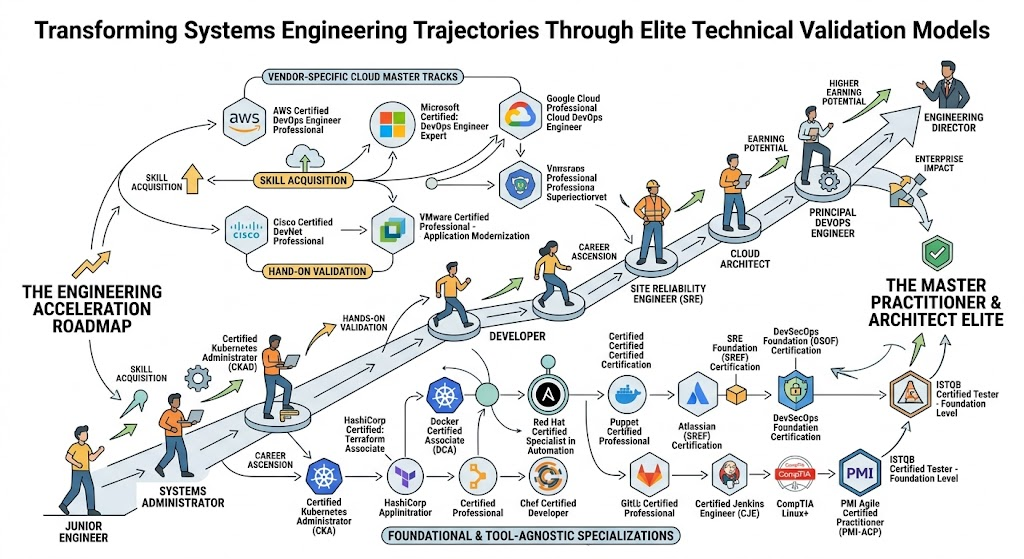
Conquering the modern software architecture landscape presents a staggering hurdle for engineering professionals aiming to claim executive technical roles. Enterprise departments relentlessly demand concrete verification of operational competencies, yet browsing the massive grid of available technology badges induces severe analytical paralysis and career delay. Fortunately, deploying a systematic training template neutralizes this operational uncertainty and sheds clear light on the exact milestones necessary for global industry respect. By securing a premium Best DevOps Certification, deployment specialists unlock intense, production-grade training frameworks that transform erratic configuration scripts into highly resilient, code-driven delivery assets. This definitive handbook maps out a meticulous strategy to break down complex architectural benchmarks, integrate hands-on coding skills with corporate deployment needs, and select the finest validation pathway for multi-year marketplace dominance.
Deconstructing The Operational Core Of Modern Validation Pathways
The Crucial Objective of Advanced Technical Credentials
An elite engineering credential explicitly validates a developer's real-world capacity to merge agile code creation cycles with secure, scalable production environments. Consequently, this formal verification proves that a deployment specialist possesses the necessary system acumen to tear down operational silos, minimize release windows, and protect application stability. Enterprise organizations utilize these standard industry filters to evaluate inbound talent, ensuring that prospective team members can architect production pipelines immediately upon arrival. Furthermore, the systematic study required for these credentials forces engineers to assimilate holistic delivery patterns rather than relying on fragmented scripting tricks.
The Mechanics Driving Contemporary Live Sandbox Environments
The assessment matrix challenges candidates through an intense combination of comprehensive scenario analysis and direct, console-based practical laboratories. Candidates must demonstrate deep familiarity with distributed source management, continuous pipeline orchestration, programmatic configuration platforms, and multi-region cloud topology. Typically, official evaluation centers administer these performance assessments within tightly monitored sandboxes where professionals solve live environment outages under strict time limits. Therefore, earning a passing mark requires an intimate, structural understanding of how disparate infrastructure nodes behave when data loads spike.
Foundational Entrance Rules vs. Corporate Engineering Expectations
Foundational entrance rules fix the strict minimum benchmarks a technician must satisfy before booking an official evaluation date, including holding prerequisite networking badges or demonstrating specific years of system administration service. Conversely, corporate engineering expectations reflect the competitive, production-grade capabilities that executive hiring managers demand when reviewing incoming candidate files. While fulfilling baseline prerequisites merely opens the door to the testing center, matching true industry selection demands that engineers back their certification with documented code repositories. Thus, obtaining the actual certificate represents only the preliminary step toward total corporate alignment.
Core Structural Pillars Formulating High-Value Cloud Credentials
Chronological Timelines and Professional Growth Stages
Although a candidate's chronological age never influences validation eligibility, their specific career stage heavily guides their choice of verification track. Early-career systems technicians frequently focus on foundational delivery tracks to quickly offset a brief professional footprint. Meanwhile, deep industry specialists leverage advanced architectural credentials to formalize decades of legacy server migration knowledge. Invariably, matching examination difficulty with current professional maturity yields the highest possible impact on an engineer's career velocity.
Dissecting Academic Degrees and Equivalency Metrics
Structured university backgrounds in software engineering or mathematics provide a valuable conceptual runway for understanding distributed systems. Nevertheless, validation panels enthusiastically accept non-traditional backgrounds provided that applicants demonstrate equivalent command over live terminal operations. Global credential services regularly review international academic profiles to guarantee that foreign coursework satisfies rigorous computer science requirements. Ultimately, verifiable programmatic capability carries far more weight than specific institutional reputations during the final review phase.
Demanding Quality Rubrics and Scoring Boundaries
Official testing systems maintain strict quality controls, routinely requiring specialists to exceed a seventy or eighty percent threshold across dynamic scoring dimensions. These criteria evaluate pipeline execution speeds, configuration security postures, secret management safety, and live service restoration workflows. Because these score boundaries remain unyielding, candidates must configure sandbox simulations repeatedly to assure compliance under stress. As a result, maintaining these high benchmarks preserves the elite market prestige of the credential over time.
Navigating Strict Professional Tenure Audits
To prevent casual study habits from diluting the value of the credential, major registry boards enforce strict workplace tenure verification procedures. Applicants submit formal corporate records, management sign-offs, and project architectural summaries detailing their hands-on usage of continuous deployment tools. Internal compliance software systematically audits these documents before issuing a permanent, verifiable credential number. Accordingly, this detailed audit phase successfully filters out purely theoretical candidates from battle-tested production engineers.
Primary Frameworks Steering Modern Architecture Specialists
The Strategic Grading Distribution Blueprint
Most examination structures divide their grading weight across several core operational modules to guarantee well-rounded architectural mastery. The following point distribution reflects the typical emphasis found within elite systems engineering evaluations:
- Continuous Integration and Delivery Integration: 30%
- Cloud Resource Orchestration and Code-Driven Infrastructure: 25%
- Cluster Monitoring, Metrics, and System Observability: 20%
- Security Automation and Compliance Enforcement: 15%
- Configuration Management and Microservice Architecture: 10%
Managing High-Stress Traffic Volatility
Engineers implement these structural frameworks directly within high-stakes corporate environments, such as managing massive backend data scaling during unannounced application traffic surges. During these high-pressure windows, a certified specialist deploys automated node scaling and service mesh isolation to protect consumer transactions. Because they deeply comprehend the architectural paradigms tested during their certification journey, these experts neutralize performance bottlenecks before users detect visible latency.
International Trajectories for Enterprise Cloud Specialists
Analyzing Agnostic Ecosystems and Vendor Matrix Paths
The international technology ecosystem organizes professional validation tracks into distinct categories based on underlying platform dependency. Vendor-agnostic tracks highlight universal engineering philosophies and open-source container platforms, whereas vendor-specific tracks immerse candidates in proprietary cloud systems like Azure or AWS. Engineers must evaluate their immediate regional market needs before selecting a path, verifying that their chosen certification matches local corporate stacks.
Charting Global Financial and Mobility Outcomes
Reviewing international technology employment trends reveals distinct, measurable advantages for professionals holding specialized infrastructure credentials. While basic delivery certificates help candidates secure entry-level systems jobs, advanced architectural validations trigger significantly higher salary metrics worldwide. Therefore, mapping out a multi-tiered certification path over several years yields the most predictable international career advancement.
Managing Complex Cross-Border Regulations and Compliances
Major regional technology hubs throughout North America, the European Union, and the Asia-Pacific territory maintain distinct regulatory parameters regarding infrastructure management. For instance, European enterprises place immense stress on strict user data privacy, meaning that localized validation tracks there emphasize data sovereignty rules. Consequently, practitioners must tune their certified engineering frameworks to conform to regional corporate compliance demands and localized engineering association bylaws. Overlooking these geographical differences severely restricts the career utility of any international credential.
Comprehensive Comparison of Elite Technology Validations
The global demand for verified cloud automation talent has established several premier validation programs, each targeting specific system administration domains. The following tabular summary details twenty industry-standard certifications available to modern technical writers and infrastructure experts, linking each to its primary framework:
| Certification Program | Primary Technical Focus | Target Audience | Market Valuation Rating |
|---|---|---|---|
| 1. DevOps Certified Professional (DCP) | End-to-End Delivery Lifecycles | Systems Engineers | 5.0 / 5.0 |
| 2. DevSecOps Certified Professional (DSOCP) | Automated Security Pipelines | Security Engineers | 5.0 / 5.0 |
| 3. Site Reliability Engineering (SRE) | System Scalability and Uptime | Operations Specialists | 5.0 / 5.0 |
| 4. Master in DevOps Engineering (MDE) | Advanced Pipeline Architecture | Senior Architects | 5.0 / 5.0 |
| 5. Master in Azure DevOps | Microsoft Cloud Ecosystems | Azure Administrators | 5.0 / 5.0 |
| 6. AWS Certified DevOps Professional | Amazon Web Services Operations | AWS Infrastructure Leads | 5.0 / 5.0 |
| 7. Google Cloud DevOps Engineer | Google Cloud Platform Automation | GCP Cloud Architects | 4.9 / 5.0 |
| 8. Certified Kubernetes Administrator (CKA) | Container Orchestration Systems | Container Administrators | 4.9 / 5.0 |
| 9. Hashicorp Certified Terraform Associate | Infrastructure as Code Assets | Automation Engineers | 4.8 / 5.0 |
| 10. Docker Certified Associate (DCA) | Containerization Fundamentals | Deployment Technicians | 4.9 / 5.0 |
| 11. Certified Kubernetes Application Developer | Cloud-Native App Deployment | Cloud Developers | 4.8 / 5.0 |
| 12. Puppet Certified Professional | Automated Configuration Systems | Systems Administrators | 4.7 / 5.0 |
| 13. Red Hat Certified Specialist in Ansible | Enterprise Automation Scripts | Linux Administrators | 4.9 / 5.0 |
| 14. GitLab Certified Git Associate | Version Control Workflows | Software Engineers | 4.7 / 5.0 |
| 15. GitHub Actions Certified Engineer | Integrated CI/CD Automation | DevOps Practitioners | 4.8 / 5.0 |
| 16. Splunk Core Certified Power User | Enterprise Telemetry Monitoring | Observability Specialists | 4.7 / 5.0 |
| 17. Prometheus Certified Associate | Cloud Metrics and Alerting | SRE Engineers | 4.8 / 5.0 |
| 18. Linux Professional Institute DevOps Tools | Open-Source Tool Integration | System Automation Techs | 4.8 / 5.0 |
| 19. ArgoCD Certified Associate | GitOps Delivery Methodologies | GitOps Architects | 4.9 / 5.0 |
| 20. Certified DevSecOps Expert (CDSOE) | Advanced Security Orchestration | Lead Security Architects | 5.0 / 5.0 |
Tangible Business and Professional Incentives
Boosting Corporate Bottom-Line Efficiency
Earning an elite system validation dramatically enhances organizational cost efficiency by drastically lowering backend application outages and reducing software delivery failure rates. Certified architects assemble durable, self-correcting pipelines that remove manual developer oversight from standard release cycles. Consequently, companies safeguard significant capital that would otherwise fund emergency hotfixes and customer service recovery.
Realizing Immediate Skillset Vulnerabilities
For individual engineers, committing to a premium certification track acts as an immediate skills diagnostic regarding their true industry capability. The standardized testing blueprint ruthlessly exposes critical technical gaps that comfortable corporate daily routines frequently obscure. By fixing these personal engineering blind spots during preparation, practitioners raise their operational skills to match world-class engineering standards.
Executing Clear Multi-Year Progression Roadmaps
Holding a globally recognized credential allows engineers to conduct strategic multi-year planning for their professional advancement. Because enterprise companies systematically select validated professionals for leadership positions, these certifications supply a clear map toward management and enterprise consulting roles. Thus, completing a certification creates a permanent career asset rather than a temporary bullet point on a profile.
Five Practical Execution Steps to Ensure Exam Success
Cataloging Essential Compliance Materials
Initiate the validation roadmap by organizing your complete academic history, previous software certificates, and authenticated reference letters documenting your server room background. Securely catalog these digital assets inside a single folder to ensure rapid presentation during the official application process. Gathering these compliance items ahead of time keeps administrative delays from pushing back your targeted test date.
Drilling in Interactive Lab Environments
Devote consistent daily blocks to running realistic practice exams, taking extreme care to reproduce actual time caps and environment constraints. Dissecting configuration mistakes inside these practice windows highlights syntax errors within your automation playbooks or cloud networking routes. Routine lab execution cultivates the critical tactile memory required to debug complex pipeline scripts under formal test parameters.
Evaluating Global Skill Demand Indices
Study current software engineering recruitment data to identify exactly which validation tracks local enterprise firms prefer before spending corporate training funds on specific exam fees. Directing your educational investments toward verified corporate demands guarantees an immediate professional payout. This proactive research ensures you avoid mastering obsolete tooling suites or niche cloud frameworks.
Merging Diverse Technical Tooling Capabilities
Enhance your core system certification by mastering highly complementary secondary skills like Python automation, telemetry logging, and SQL cluster administration. These extra modules grant a major advantage, enabling engineering candidates to construct comprehensive cloud systems that far outpace fundamental exam demands. Expanding your multi-tool utility ensures your profile stands out clearly in high-volume hiring pipelines.
Completing the Final Evaluation Matrix
Confirm your exam readiness by securing a consistent score above eighty-five percent on comprehensive simulator platforms before executing your official registration. Once you maintain this stable passing baseline, formally schedule your date through an authorized testing provider. Taking this calculated step guarantees that you approach the terminal with maximum technical certainty and optimal mental readiness.
Strategic Tactics Designed To Elevate Examination Scores
Emphasizing Deep Broken-State Sandbox Recovery
Accelerate your learning pace by creating a rigid, daily study track focused entirely on interactive terminal usage instead of passively watching tutorial videos. Intentionally corrupt your own local container networks, then train yourself to recover normal application states without looking up external answers. This rigorous hands-on troubleshooting method deepens conceptual retention and sharpens command-line speed during live testing.
Packaging Layered Structural Portfolios
Combine your broad foundational delivery certificates with deep specialized modules like the Certified Kubernetes Administrator path to build an unassailable tech portfolio. This tactical approach communicates to prospective corporate employers that you possess both macro architectural awareness and microscopic component dexterity. Consequently, stacking these credentials provides major leverage when discussing compensation tiers with HR executives.
Targeting Regulated Specialized Industries
Target highly profitable, specialized market channels like international financial tech or secure defense platforms by augmenting your core system credentials with advanced security options. These highly regulated business sectors pay massive premiums for infrastructure engineers who can automate delivery while meeting severe government data audits. Therefore, aiming your study toward these compliant fields completely bypasses generic engineering talent pools.
Costly Blind Spots To Eradicate From Your Training Schedule
Dozens of skilled engineers fail their initial system evaluation because they misjudge the difficulty of the material and rely too heavily on casual workspace habits. Typical company routines frequently incorporate non-standard practices or brittle hotfixes that contradict the pristine, best-practice methodologies mandated by official testing rubrics. Furthermore, applicants routinely select irrelevant technical streams that do not match their actual daily production tasks, causing intense confusion during lab scenarios. Finally, technicians frequently neglect to review basic facility policies, leading to sudden disqualification at the entrance due to expired personal identification or outdated prerequisite records. Evading these simple procedural and mental errors ensures a flawless, single-attempt passing score.
Real-Life Chronicles of Successful System Upgrades
The Rapid Trajectory of an Associate Technician
An energetic junior developer possessing only a basic associate degree found that their resume lacked the authority to interest major corporate teams. To conquer this barrier, they dedicated four months of evenings to conquering the entry-level DevOps Certified Professional track. Right after earning the credential, an international fintech group hired them as a deployment analyst, shortening their career ascent by several years.
Revitalizing a Legacy Infrastructure Career
A veteran infrastructure specialist with fifteen years of traditional physical server room management faced sudden career stagnation as modern firms moved toward cloud clusters. Recognizing this market pivot, they pursued the advanced AWS Certified DevOps Professional validation track to rewrite their technical resume. This deliberate educational investment allowed them to pivot effortlessly into a principal cloud infrastructure role, securing their market relevance.
The Automated Security Transformation Path
A mid-level application programmer operating inside a tightly checked pharmaceutical enterprise wanted to shift entirely into automated defense systems. They centered their energy on the DevSecOps Certified Professional curriculum, mastering continuous security scanning and automated network policy deployment. As a result, their executive team promoted them to Lead DevSecOps Architect, making them the most valuable compliance resource in the division.
Frequently Asked Questions (FAQs)
- What particular validation stream secures the highest baseline compensation for enterprise architects? The AWS Certified DevOps Professional and Master in DevOps Engineering tracks yield the highest immediate market premiums due to widespread global enterprise adoption.
- Can an engineering professional pass these multi-tier performance tests without an academic degree background? Yes, major technology registration boards evaluate direct terminal competency and successful lab performance over traditional academic institutional backgrounds.
- How long do premium cloud infrastructure badges stay active before requiring validation renewals? The majority of premier tech providers require practitioners to recertify every three years to keep their skills current with rapid infrastructure changes.
- What baseline structural elements differentiate open-source agnostic tracks from vendor-focused certifications? Vendor-agnostic certifications teach universal, open-source cloud concepts, whereas vendor-specific options focus exclusively on proprietary platforms like Azure.
- Do these production-grade exam sandboxes require fluid scripting competence from candidates? Yes, contemporary systems validation requires candidates to write functional infrastructure code and clean automation scripts using Python, Go, or Bash.
- How many hours of console work should a candidate execute before registering for their official slot? Most engineers schedule their exams after dedicating three to six months of structured daily terminal practice and sandbox simulator testing.
- Why do technology recruitment panels relentlessly hunt for specific orchestration badges like the CKA? Container clustering forms the architectural backbone of modern cloud software, making validated Kubernetes expertise incredibly rare and highly prized.
- What cooling-off regulations apply if an individual misses the designated passing score threshold? Testing platforms permit applicants to book a secondary exam appointment after a brief mandatory waiting window and payment of standard retake fees.
- Do modern certification bodies support remote proctored testing tracks for home office spaces? Yes, registration systems utilize secure, web-camera monitored proctoring software to let professionals take their exams from private office environments.
- Does a backend application creator gain measurable leverage by finishing an automation certificate path? Absolutely, developers who master cloud delivery infrastructure eliminate organizational bottlenecks, making themselves uniquely valuable to modern cross-functional engineering teams.
CONCLUSION
Pledging your focus to an advanced systems certification marks a definitive turning point for technology professionals determined to establish authentic authority in a crowded global marketplace. Rather than relying on unverified resume bullet points, engineers who conquer rigorous practical examinations present undeniable, concrete proof of infrastructure mastery. These structured validation pathways sweep away professional stagnation, systematically reshaping ambitious system technicians into elite cloud architects who steer major corporate tech migrations. Devoting the daily focus required to dominate these comprehensive assessments delivers substantial returns in long-term career safety, executive compensation, and fluid international mobility. Ultimately, stepping forward to claim a verified professional rank ensures your place at the absolute command center of the global software delivery revolution.



Top comments (0)