
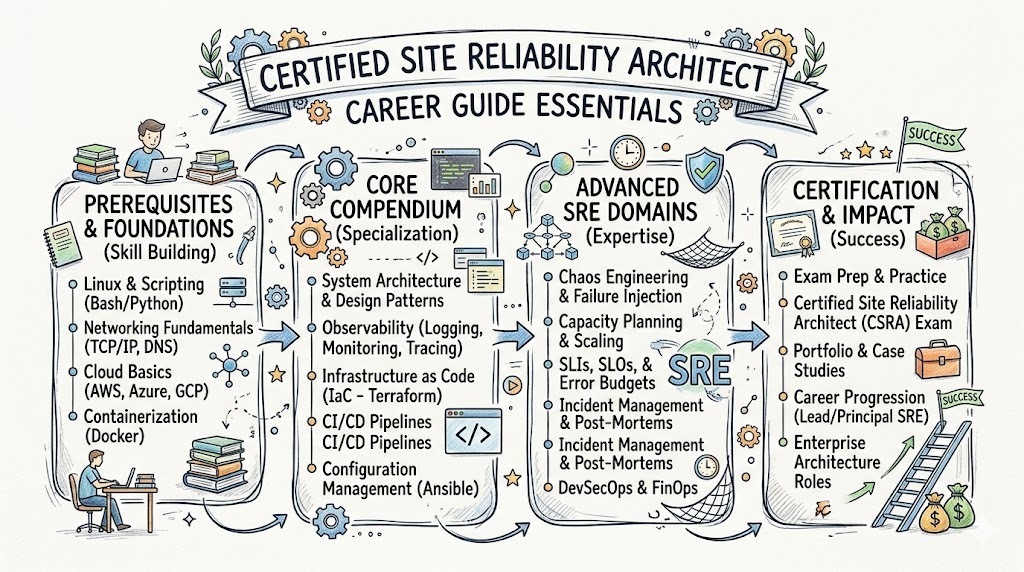
Introduction
Modern enterprise software systems require robust, scalable, and resilient frameworks to maintain peak operational efficiency. Engineers frequently encounter complex infrastructure challenges that demand deep architectural insights rather than basic administration skills. Therefore, professionals must upgrade their technical capabilities to bridge the gap between software development and large-scale IT operations. This comprehensive guide evaluates the Certified Site Reliability Architect program offered by Sreschool, explaining how it transforms traditional engineering careers. By examining this roadmap, technology leaders and practitioners can make informed decisions regarding their professional upskilling investments.
What is the Certified Site Reliability Architect?
The Certified Site Reliability Architect represents an elite tier of professional validation that focuses on designing fault-tolerant, highly available systems. Consequently, this program moves beyond theoretical infrastructure concepts and forces engineers to tackle real-world production failures, systemic bottlenecks, and automation challenges. Enterprises heavily rely on these architectural principles to ensure that software services meet strict service level objectives while scaling seamlessly. By focusing heavily on distributed systems engineering, the program establishes a standardized framework for managing telemetry, container orchestration, and chaos testing in production.
Who Should Pursue Certified Site Reliability Architect?
This certification specifically targets intermediate to senior technical professionals who manage cloud-native infrastructure, deployment pipelines, and production environments. For instance, systems engineers, cloud architects, and veteran developers looking to pivot into advanced operational roles will find immense value here. Additionally, technical managers and engineering leaders can leverage this knowledge to build high-performing engineering cultures that prioritize reliability from day one. Both the Indian enterprise market and the global technology sector show a massive demand for professionals who possess these verified architectural capabilities.
Why Certified Site Reliability Architect is Valuable in the Long Run
Technology stacks evolve rapidly, but core architectural principles regarding high availability, latency reduction, and disaster recovery remain constant over decades. Hence, securing this certification helps professionals safeguard their careers against specific tool obsolescence by instilling deep foundational design patterns. Organizations continuously seek architects who can balance rapid feature deployment with absolute system stability to maximize business continuity. Ultimately, the return on time investment manifests as accelerated career progression, higher technical authority, and the ability to lead enterprise-wide cloud transformations.
Certified Site Reliability Architect Certification Overview
The structured educational program is delivered via the official training portal and hosted securely on the primary platform. Candidates must undergo rigorous assessment phases that combine comprehensive conceptual examinations with practical, hands-on lab evaluations to prove architectural competency. The certification structure ensures that individuals do not merely memorize command-line tools but thoroughly understand the behavioral characteristics of complex distributed networks. This independent validation framework provides clear professional credibility that enterprises trust during critical hiring and promotion cycles.
Certified Site Reliability Architect Certification Tracks & Levels
The curriculum spans across three distinct progressive tiers, starting from foundational principles and advancing into deep strategic implementation methodologies. Specialized engineering tracks allow practitioners to align their validation path with specific domains such as performance engineering, cloud financial management, or automated security. As candidates ascend through these hierarchical levels, the focus shifts entirely from individual component configuration to holistic system architecture. This methodical progression guarantees that certified professionals can confidently step into high-impact roles within enterprise engineering teams.
Complete Certified Site Reliability Architect Certification Table
| Track | Level | Who it’s for | Prerequisites | Skills Covered | Recommended Order |
|---|---|---|---|---|---|
| Core SRE | Foundation | Systems Engineers | Basic Linux & Networking | Telemetry, SLA, SLI, SLO, Incident Response | First |
| Architecture | Professional | Senior SREs | Foundation Certificate | Distributed Systems, Chaos Engineering | Second |
| Enterprise | Advanced | Principal Architects | Professional Certificate | DR Design, Multi-Region Scale, Mesh Networks | Third |
Detailed Guide for Each Certified Site Reliability Architect Certification
Certified Site Reliability Architect – Foundation Level
What it is
This baseline certification validates an engineer's core understanding of reliability metrics, monitoring ecosystems, and basic incident mitigation workflows within production environments.
Who should take it
Systems administrators, junior DevOps engineers, and software developers who need to understand how their code behaves after deployment.
Skills you’ll gain
- Defining accurate service level indicators and objectives
- Configuring full-stack monitoring and alerting dashboards
- Implementing basic root cause analysis workflows
Real-world projects you should be able to do
- Construct a Prometheus and Grafana monitoring stack for a microservices application
- Design an automated alerting pipeline based on error budget consumption rates
Preparation plan
- 7–14 Days: Focus on core SRE definitions, terminology, and standard mathematical formulas for calculating availability.
- 30 Days: Complete all hands-on labs related to basic log aggregation and dashboard creation across cloud environments.
- 60 Days: Review real-world case studies of system failures and take mock examinations to ensure complete conceptual clarity.
Common mistakes
Candidates often spend too much time memorizing specific software configurations instead of mastering the underlying architectural metrics and philosophies.
Best next certification after this
- Same-track option: Certified Site Reliability Architect – Professional Level
- Cross-track option: Cloud Infrastructure Specialist
- Leadership option: Technical Team Lead Foundation
Certified Site Reliability Architect – Professional Level
What it is
This intermediate certification verifies an engineer's capability to design resilient distributed systems, manage complex automation pipelines, and handle large-scale incident responses.
Who should take it
Experienced site reliability engineers, DevOps specialists, and cloud engineers responsible for maintaining multi-tier production workloads.
Skills you’ll gain
- Advanced chaos engineering and failure injection methodologies
- Designing automated self-healing infrastructure patterns
- Managing high-load traffic distribution and load balancing
Real-world projects you should be able to do
- Implement a continuous chaos testing pipeline using Chaos Mesh to validate cluster resilience
- Configure an automated horizontal scaling mechanism that responds to custom application telemetry
Preparation plan
- 7–14 Days: Deep dive into distributed system design patterns, focusing on circuit breakers and rate limiting.
- 30 Days: Build and break multi-region infrastructure setups inside local sandboxes or cloud environments to practice recovery.
- 60 Days: Study advanced networking protocols, service mesh configurations, and execute complex failure scenario simulations.
Common mistakes
Many applicants fail because they underestimate the deep networking and distributed system communication concepts tested during the practical examination phase.
Best next certification after this
- Same-track option: Certified Site Reliability Architect – Advanced Level
- Cross-track option: Advanced Cloud Security Specialist
- Leadership option: Engineering Manager Professional
Certified Site Reliability Architect – Advanced Level
What it is
This premier tier validates absolute mastery over global enterprise infrastructure design, comprehensive disaster recovery planning, and strategic technology direction.
Who should take it
Principal engineers, enterprise infrastructure architects, and technical directors who oversee massive global digital platforms and distributed engineering organizations.
Skills you’ll gain
- Multi-region active-active database replication architecture design
- Defining enterprise-wide infrastructure reliability standards and governance
- Architecting global traffic management and content delivery networks
Real-world projects you should be able to do
- Design and execute a zero-downtime database migration across two distinct cloud providers under simulation
- Formulate a comprehensive disaster recovery automation system that satisfies a near-zero recovery time objective
Preparation plan
- 7–14 Days: Review enterprise architecture frameworks, compliance mandates, and high-level corporate disaster recovery methodologies thoroughly.
- 30 Days: Analyze massive system architectural failures from major tech enterprises to understand compounding cascading infrastructure bugs.
- 60 Days: Practice designing end-to-end global architectures on paper and validate cost-to-performance choices through mathematical calculations.
Common mistakes
Experienced candidates sometimes rely too heavily on their past company-specific workflows instead of adopting standardized global enterprise architectural patterns.
Best next certification after this
- Same-track option: Specialized Cloud Quantum Architecture
- Cross-track option: Enterprise FinOps Director
- Leadership option: Chief Technology Officer Strategy
Choose Your Learning Path
DevOps Path
Professionals on this trajectory focus heavily on the integration of software development pipelines with automated infrastructure provisioning workflows. Consequently, mastering reliability architecture allows these engineers to build delivery systems that do not compromise production stability during frequent deployments. They bridge the gap between rapid feature releases and long-term system availability by integrating robust telemetry collection directly into code.
DevSecOps Path
This specialized track infuses comprehensive security protocols into every layer of the automated infrastructure and reliability lifecycle seamlessly. Practitioners learn to build automated threat detection mechanisms, secure service meshes, and resilient access controls that operate at immense scale. The ultimate goal remains maintaining system reliability even while experiencing severe distributed denial of service attempts or active cyber security breaches.
SRE Path
The core SRE track focuses directly on systems engineering principles applied specifically to complex software operational challenges across global networks. Engineers spend their time optimizing code performance, managing infrastructure capacity, automating repetitive operational tasks, and conducting meticulous post-mortem investigations. This path directly transforms traditional infrastructure operators into highly capable software systems architects who manage production mathematically.
AIOps Path
This modern path leverages machine learning models and intelligent algorithms to automate root cause analysis, predict anomalies, and streamline telemetry analysis. Engineers learn how to feed massive streams of system logs and performance metrics into computational systems to detect impending failures before they impact users. This represents the future of autonomous, self-healing enterprise systems operating across thousands of microservices nodes simultaneously.
MLOps Path
Focusing on the operational side of artificial intelligence, this path ensures that machine learning pipelines remain highly reliable, scalable, and stable. Professionals architect systems that manage heavy training data sets, track model drift, and handle computational bursts across large graphics processing clusters. They ensure that intelligence-driven software services maintain the exact same uptime standards as traditional enterprise web applications.
DataOps Path
Data-focused professionals utilize these architectural principles to construct resilient, high-throughput data processing pipelines, data lakes, and real-time streaming infrastructure. They eliminate data corruption, manage distributed database clustering, and optimize query latency across multi-terabyte transactional storage layers. This guarantees that analytics and business intelligence systems remain highly accurate and continuously available for corporate decision-making.
FinOps Path
This economic framework combines architectural engineering decisions directly with cloud financial management strategies to optimize corporate technology spend. Engineers learn how to design highly reliable, auto-scaling systems that dynamically shrink or expand to eliminate wasteful resource allocation. They ensure that the corporate cloud footprint delivers maximum system performance and reliability at the absolute lowest financial price point.
Role → Recommended Certified Site Reliability Architect Certifications
| Role | Recommended Certifications |
|---|---|
| DevOps Engineer | Foundation Level, Professional Level |
| SRE | Professional Level, Advanced Level |
| Platform Engineer | Foundation Level, Professional Level |
| Cloud Engineer | Foundation Level, Professional Level |
| Security Engineer | DevSecOps Specialization Tracker |
| Data Engineer | DataOps Architecture Specialization |
| FinOps Practitioner | FinOps Structural Track |
| Engineering Manager | Foundation Level, Leadership Track |
Next Certifications to Take After Certified Site Reliability Architect
Same Track Progression
Upon completing the advanced tier, engineers should pursue deep niche specializations within the reliability ecosystem to solidify their market standing. For instance, moving into hyper-scale cluster networking, real-time forensic system kernel analysis, or specialized hardware performance tuning represents logical progressions. This continuous deep specialization establishes professionals as elite industry experts capable of resolving the most complex infrastructure problems.
Cross-Track Expansion
Broadening technical capabilities requires professionals to acquire certifications in adjacent fields such as advanced data management or machine learning operations. Understanding how complex data pipelines interact with underlying cloud architecture allows an SRE architect to design comprehensive systems. This horizontal skill expansion ensures that engineers do not become siloed within simple infrastructure provisioning tasks over time.
Leadership & Management Track
Transitioning from technical implementation to strategic organizational governance demands a focus on team scaling, corporate budgeting, and risk management frameworks. Therefore, moving toward enterprise technology strategy certifications allows veteran architects to step comfortably into director or executive roles. This pathway enables individuals to design not just the technical infrastructure, but the entire human engineering organization.
Training & Certification Support Providers for Certified Site Reliability Architect
DevOpsSchool delivers highly structured technical training programs tailored for enterprise teams seeking to master modern cloud-native deployment patterns and continuous integration strategies. The institution provides deep architectural overviews alongside extensive hands-on laboratory environments to ensure practical skill retention for students.
Cotocus specializes in providing accelerated technical bootcamp sessions focused heavily on production environment simulations, advanced container orchestration systems, and infrastructure automation workflows. Their curriculum matches modern enterprise demands perfectly.
Scmgalaxy offers a massive repository of educational content, practical tutorials, and expert-led community forums designed to support engineers mastering configuration management. The platform emphasizes real-world implementation mechanics over theoretical concepts.
BestDevOps focuses on delivering high-quality training modules centered on continuous testing automation, infrastructure as code methodologies, and modern microservices monitoring solutions. Their courses help professionals upskill rapidly.
devsecopsschool.com provides targeted educational pathways focused entirely on integrating automated security scanning tools and compliance validation frameworks directly into software delivery lifecycles. They bridge security with modern operations.
sreschool.com serves as a premier training destination for individuals pursuing deep expertise in distributed systems architecture, advanced chaos testing, and enterprise telemetry systems. The platform focuses heavily on high-availability engineering.
aiopsschool.com trains modern engineering professionals on how to effectively apply artificial intelligence models and predictive machine learning algorithms to complex infrastructure operational tasks. They lead the automated operations space.
dataopsschool.com delivers comprehensive instructional content focused on optimizing distributed data pipelines, managing data warehouse scale, and ensuring absolute data stream reliability across enterprises. They master big data infrastructure.
finopsschool.com teaches engineering leaders and finance professionals how to build structured cloud financial management strategies that reduce resource waste without sacrificing application performance. They optimize infrastructure spend.
Frequently Asked Questions
- How difficult is the architectural examination compared to basic engineering tests? The assessment process demands significant analytical thinking, as it focuses entirely on deep architectural design scenarios rather than simple command syntax.
- How much time does an average working professional need to dedicate to pass? Most engineers possessing prior infrastructure experience require approximately sixty days of consistent study to fully absorb the advanced curriculum materials.
- Are there strict technical prerequisites required before challenging the professional exam? Yes, candidates must successfully pass the initial foundation level evaluation or demonstrate equivalent verified experience in managing live production environments.
- What specific career opportunities open up after obtaining this architectural credential? Professionals routinely secure high-level roles such as Principal SRE, Infrastructure Architect, or Director of Platform Engineering within top global enterprises.
- Does the certification focus on one specific cloud provider like AWS or Azure? No, the core curriculum remains completely cloud-agnostic, focusing instead on universal architectural principles applicable across all public and private cloud environments.
- How frequently must certified professionals renew their credentials to maintain active status? The architectural validation remains valid for three years, after which individuals must complete a delta examination or show continuing professional education credits.
- Is there a heavy coding requirement within the examination phases? Candidates must demonstrate proficiency in reading and writing infrastructure automation scripts, basic system utilities, and interpreting application log outputs accurately.
- How does this program help an engineering manager lead technical teams better? It equips managers with the exact vocabulary, architectural patterns, and performance metrics required to evaluate and guide highly complex infrastructure initiatives.
- Can software developers transition directly into this architectural track easily? Yes, developers with a strong grasp of operating system fundamentals and networking can leverage this pathway to transition into high-paying reliability roles.
- What is the global industry recognition level for this specific program? Enterprises worldwide recognize this credential because the rigorous practical testing structure ensures that certified individuals possess real, verifiable engineering capabilities.
- Are hands-on practical laboratories included within the official educational curriculum? Yes, the training framework places immense emphasis on interactive sandboxes where candidates build, break, and repair complex simulated distributed infrastructure environments.
- How does this credential directly improve an engineer's salary potential? By transforming a standard administrator into a highly strategic systems architect, professionals significantly increase their market value and negotiation leverage globally.
FAQs on Certified Site Reliability Architect
- What core architectural philosophy separates this program from general DevOps certifications? This program treats operational infrastructure challenges strictly as software engineering problems. While general DevOps paths focus heavily on continuous integration pipelines and delivery toolchains, this architecture path demands deep mastery over distributed systems design, memory management, and network topology.
- How does the curriculum address modern multi-cloud enterprise infrastructure strategies? The architecture curriculum assumes that modern enterprises operate across multiple cloud providers and hybrid data centers. Therefore, it focuses heavily on building abstract orchestration layers, cloud-agnostic service meshes, and global traffic routing patterns that prevent vendor lock-in completely.
- What specific chaos engineering methodologies are tested during the practical phases? Candidates are evaluated on their ability to design controlled failure experiments within production microservices. This includes simulating network latency, injecting memory leaks, terminating cluster nodes unexpectedly, and validating that the self-healing automation systems react within defined parameters.
- How are service level metrics calculated and validated under this framework? The certification forces engineers to move away from vanity metrics like simple CPU utilization. Instead, it teaches the mathematical formulation of user-centric indicators that directly measure successful request ratios, database latency, and error budget exhaustion rates accurately.
- Can this certification help organizations reduce their annual cloud infrastructure expenditures? Yes, an architect trained under this methodology learns to design highly efficient systems that eliminate over-provisioning through advanced auto-scaling algorithms. By optimizing container layouts and database queries, certified professionals drastically lower resource consumption costs.
- What level of networking knowledge is required to succeed in this program? Professionals need a deep understanding of layer four and layer seven load balancing, DNS routing, secure tunneling protocols, and service mesh patterns. The exam requires candidates to diagnose complex routing failures across distributed container clusters efficiently.
- How does the training prepare engineers to handle massive unexpected traffic surges? The curriculum covers advanced rate limiting, caching strategies, circuit breaker implementation, and graceful degradation patterns. Architects learn how to configure systems so that under extreme load, non-essential services drop off while core transactional processes remain alive.
- Why do enterprises prioritize hiring certified architects over self-taught infrastructure engineers? Enterprise systems carry immense financial risk if they experience prolonged downtime. This certification provides formal, independent validation that an engineer has studied standardized mitigation patterns and can handle high-stress production incidents methodically without panic.
Final Thoughts: Is Certified Site Reliability Architect Worth It?
Investing time and professional effort into an advanced technical certification is a serious commitment that requires careful consideration. From an industry perspective, simple tool administration is rapidly becoming automated through intelligent software frameworks and cloud native services. Consequently, the true value of an engineer now lies in their ability to design holistic, resilient, and cost-effective distributed architectures. This program offers a clear, highly structured, and rigorous pathway to achieving that elite level of technical capability. For any professional serious about leading large-scale infrastructure transformations and securing high-impact engineering roles, this validation represents a sound career choice.



Top comments (0)