
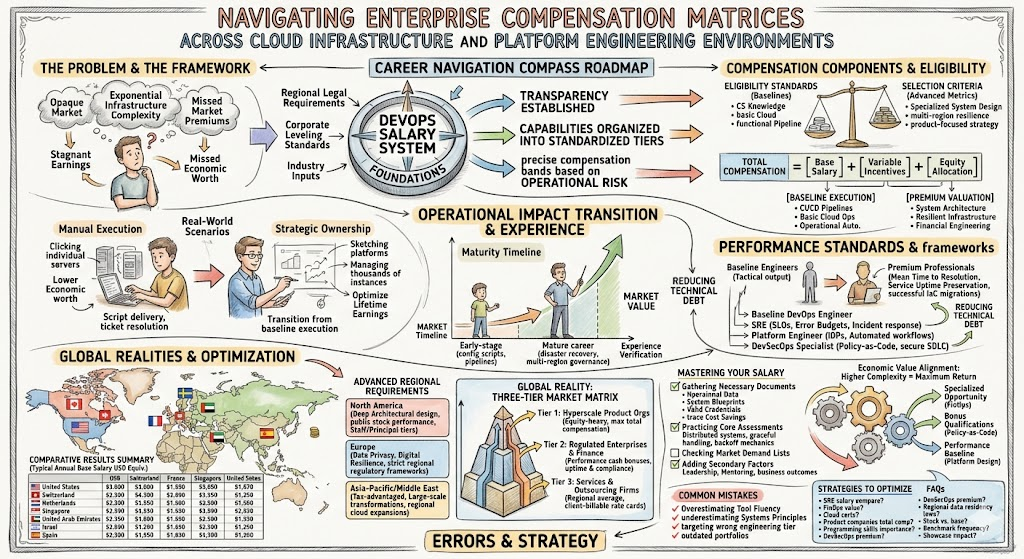
Engineers operating within the modern cloud ecosystem encounter an incredibly fluid corporate landscape where specialized technical talent commands massive financial premiums. Navigating contract negotiations without precise, verified industry data frequently leaves software professionals significantly underpaid relative to their operational responsibilities. Corporate hiring teams intentionally establish intricate, opaque internal tier structures to protect company operational budgets during the recruitment cycle. Consequently, engineering candidates require an objective, data-backed strategy to accurately align their hands-on capabilities with true top-of-market rewards. Investigating this specific salary infrastructure provides software professionals with a pristine, actionable blueprint to systematically maximize their total career earnings.
What Is a Best DevOps Salary?
The Core Purpose of Best DevOps Salary
This analytical financial framework acts as an essential corporate equalizer for tech professionals navigating a highly fragmented employment market. Companies regularly cycle through trending titles and variable job descriptions, masking highly advanced systems architecture roles under generic staff descriptions to save on hiring expenses. Therefore, this data-driven benchmark provides an unwavering baseline that calculates an engineer's true economic output based on their systemic liabilities. By mapping production-floor responsibilities directly to verified enterprise revenue generation, it empowers specialists to dictate favorable contract terms.
How the Best DevOps Salary System Works
The evaluation system continuously aggregates live industry inputs, venture capital funding shifts, corporate infrastructure scales, and regional cost-of-living coefficients. It processes these diverse data streams to separate basic pipeline executors from high-leverage platform architects who manage broad organizational workflows. The matrix then translates these distinct execution layers into highly defined, predictable compensation bands. This structured methodology guarantees that an engineer's final valuation mirrors the exact operational and financial risk they mitigate for the enterprise.
Eligibility Standards vs. Selection Criteria
Engineering candidates must carefully distinguish between foundational baseline parameters and premium competitive attributes during their career planning.
- Eligibility Standards: These baseline metrics comprise basic requirements like writing functional deployment scripts, configuring single-cloud resources, and managing standard code repositories.
- Selection Criteria: These advanced markers dictate whether an applicant qualifies for elite, top-tier compensation brackets. High-paying organizations prioritize multi-region disaster recovery engineering, programmatic policy enforcement, and massive cloud cost optimization to justify peak financial offers.
Best DevOps Salary Components: The Building Blocks
Age Factors in Best DevOps Salary
Within this specific compensation architecture, "age" refers exclusively to the architectural maturity of an engineer's production systems exposure rather than chronological years. Early-career practitioners typically focus on localized code compilation, simple software packaging, and basic configuration adjustments, positioning them within entry-level salary tiers. Conversely, as an engineer's systems exposure reaches deep maturity, their focus shifts toward cross-team platform scalability, enterprise-wide security governance, and multi-region resilience. This proven capability to safeguard business continuity significantly accelerates a professional's market premium.
Educational Evaluation for Best DevOps Salary
Traditional academic degrees establish a reliable analytical baseline, but continuous, self-directed credential validation ultimately dictates long-term compensation growth in modern systems. While a computer science degree satisfies initial automated human resources screening filters, specialized cloud-native certifications offer immediate proof of real-world operational capability. Hands-on validations from major cloud hyperscalers confirm that a specialist can confidently handle high-stress production environments. Ultimately, a balanced combination of core algorithmic understanding and active cloud credentials unlocks the highest starting compensation offers.
Performance Standards and Benchmarks
Corporate compensation tiers correlate directly with verifiable, metrics-driven system performance outcomes.
- Baseline Engineers: Managers evaluate these practitioners on simple output metrics, including script delivery timelines, ticket closure rates, and basic pipeline builds.
- Premium Professionals: Leadership judges these specialists on system-wide ecosystem health indicators, such as Mean Time to Resolution (MTTR) reduction, deployment failure minimization, and cloud budget efficiency.
Progressive companies aggressively reward specialists who proactively eliminate engineering toil and prevent catastrophic system outages.
Professional Experience Verification
Enterprise recruitment pipelines scrutinize the exact corporate environments where an engineering candidate previously deployed software. Having hands-on exposure inside hyper-growth product businesses or highly regulated financial institutions commands an immediate premium over generalized IT consulting work. This market premium exists because hiring teams actively search for talent that has faced massive web traffic spikes, complex security threats, and strict compliance audits. Documented ownership of highly scalable production systems serves as your primary leverage during salary discussions.
Primary Frameworks Governing Best DevOps Salary
The Detailed Score Breakdown
To fully unlock your maximum earning capability, you must understand how distinct specialized paths command varying market premiums based on system complexity and operational risk.
- Automation Generalist (Foundational Layer): Focuses on managing continuous integration pipelines, updating software build tools, and handling routine server deployments.
- Site Reliability Engineer [Premium: +10% to +15%]: Manages service level objectives (SLOs), engineers automated self-healing software frameworks, and guides high-stress incident responses.
- Platform Engineer [Premium: +5% to +20%]: Constructs unified internal developer platforms (IDPs) that eliminate operational friction and accelerate software delivery for product teams.
- DevSecOps Specialist [Premium: +15% to +35%]: Integrates automated policy compliance, continuous vulnerability scanning, and secure identity access management directly into delivery workflows.
Real-World Application Scenarios
When an enterprise transitions its core services from manual server provisioning to dynamic, declarative cloud-native setups, the financial valuation of its engineering talent shifts immediately. For example, a practitioner who manually tweaks individual server configurations remains pinned to lower-tier salary brackets. Conversely, an engineer who codifies entire global data centers using software templates transitions directly into a premium compensation tier. This divergence occurs because code-driven automation allows a single specialist to safely govern millions of dollars in enterprise digital assets.
International Pathways for Best DevOps Salary
Key Categories and Classes
The international technology labor market divides engineering compensation systems into three distinct corporate business models:
- Global Product Pioneers: These organizations offer equity-heavy compensation packages featuring highly liquid stock grants, driving total remuneration to the peak of the global tech market.
- Regulated Financial & Enterprise Institutions: These companies provide highly stable, base-salary-heavy frameworks paired with substantial performance-based cash bonuses tied to system availability goals.
- Regional IT Integration & Service Firms: These businesses utilize rigid, billable rate-card models determined strictly by local regional averages and client consulting hours.
Comparative Results Summary
Engineers looking to optimize their career trajectories must analyze how compensation fluctuates across different regions. The index below highlights typical annual base salary structures for primary infrastructure engineering profiles across multiple target countries.
| Country | Currency | DevOps Baseline (USD Equiv.) | Site Reliability Eng. (USD Equiv.) | Platform Engineer (USD Equiv.) | DevSecOps Specialist (USD Equiv.) |
|---|---|---|---|---|---|
| United States | USD | $115,072 | $124,278 | $128,881 | $135,785 |
| Switzerland | CHF | $143,353 | $154,821 | $160,555 | $169,156 |
| Netherlands | EUR | $89,537 | $96,700 | $100,281 | $105,653 |
| Singapore | SGD | $89,149 | $96,281 | $99,847 | $105,196 |
| Canada | CAD | $83,417 | $90,091 | $93,427 | $98,432 |
| France | EUR | $80,510 | $86,951 | $90,172 | $95,002 |
| United Arab Emirates | AED | $79,059 | $85,384 | $88,546 | $93,290 |
| Israel | ILS | $78,146 | $84,398 | $87,523 | $92,212 |
| Sweden | SEK | $72,227 | $78,005 | $80,894 | $85,228 |
| Spain | EUR | $68,935 | $74,450 | $77,207 | $81,343 |
Advanced Regional Requirements for Best DevOps Salary
North American Market Dynamics
The highly competitive North American technology market aggressively rewards engineers who couple deep architectural vision with programming fluency. In this territory, pure infrastructure administration commands lower financial packages, while positions requiring custom automation software design claim top-tier market rewards. Specialists must successfully climb structured corporate leveling ladders, where reaching Principal status requires influencing multi-department engineering roadmaps. Furthermore, total packages remain heavily dependent on volatile stock performance, directly aligning personal earnings with business valuations.
European Regulatory Environments
European technology centers place a high financial premium on long-term data privacy laws, digital operational resilience directives, and localized cloud sovereign controls. Consequently, infrastructure professionals operating in these zones must demonstrate a deep understanding of complex regional compliance guardrails. Compensation frameworks here emphasize predictable base salaries, extensive social safety nets, and highly structured corporate leveling adjustments. Advanced engineering roles inside banking hubs command higher packages due to the strict penalties tied to financial system outages.
Asia-Pacific and Middle Eastern Growth Hubs
Rapidly developing digital zones across the Asia-Pacific and Middle Eastern markets actively recruit international engineering talent by offering tax-advantaged compensation models. These territories prioritize large-scale cloud transformations, smart-city deployments, and geographic cloud infrastructure expansions. Consequently, organizations reward specialists who can reliably architect highly secure, multi-region setups from scratch. Because local talent availability remains constrained, corporations willingly pay massive premiums to attract foreign infrastructure leaders.
The Global Landscape of Best DevOps Salary
=====================================================================
                    GLOBAL COMPENSATION PATHWAYS
=====================================================================
 [High-Scale Product]   --> Massive Liquid Equity + Stock Optimization
 [Regulated Enterprise] --> Strong Base Salaries + Performance Bonuses
 [Consulting Services]  --> Rigid Rate-Card Scales + Certified Growth
=====================================================================
Navigating Tier 1 Product Environments
Entering an elite tech ecosystem requires passing intense software engineering interviews focused on algorithms and system design. These organizations look for engineers who can write highly optimized, clean application code and construct globally distributed, self-healing platforms. The internal compensation logic here rewards systemic automation impact rather than repetitive operational maintenance. Engineers who directly tie their infrastructure platforms to accelerated developer shipping speed unlock the highest equity values.
Operating in Tier 2 Enterprise Systems
Regulated corporate environments judge engineering talent by an applicant's ability to minimize compliance liabilities and guarantee constant service uptime. These businesses intentionally prioritize system stability and regulatory compliance over hyper-rapid code updates. As a result, compensation structures focus on competitive base salaries combined with large cash incentives tied to corporate uptime goals. Engineers thrive in this space by mastering automated security validation, programmatic compliance checks, and highly disciplined disaster recovery operations.
Analyzing Tier 3 Service Provider Paradigms
Consulting businesses operate on rigid, client-funded project rate cards, which produces highly structured and predictable salary progressions. Within this business model, annual salary jumps map directly to billable hour metrics, client satisfaction ratings, and the continuous collection of cloud partner certifications. While these roles provide excellent exposure to a wide variety of customer infrastructure setups, long-term salary growth remains limited by corporate profit margins. Wise professionals use these positions to build strong project portfolios before moving to product-centric enterprises.
Benefits of Utilizing a Best DevOps Salary Calculator
Cost Efficiency in Career Decisions
Using an objective financial benchmark prevents engineers from executing blind career changes based on incomplete market information. Professionals can accurately measure their current technical value against real-world data before accepting or declining internal counteroffers. This clarity ensures that individuals do not leave large amounts of money behind when switching jobs. Treating your personal career progression with the same data-driven precision you apply to system architecture planning maximizes your lifetime earnings.
Instant Reality Checks
An objective data platform provides an immediate check on how the wider industry values your current technical skill set. It removes emotion from the negotiation process by revealing exactly where your current package sits relative to local market averages. If you find yourself undercompensated compared to your system liabilities, you can confidently enter salary reviews backed by hard industry statistics. Conversely, it alerts top earners when they have reached a regional salary ceiling, indicating a need to expand their scope toward cross-team platform management.
Strategic Long-Term Planning
Mapping your daily skill development to high-paying market trends allows you to build a highly lucrative, long-term professional roadmap. For example, when market data shows that security-focused cloud roles secure a 30% salary premium, you can intentionally shift your focus toward secure delivery pipelines. This proactive pathing transforms your career from a series of random jobs into a deliberate sequence of high-value skill additions. By targeting high-impact engineering niches, you insulate your earnings from shifting economic conditions.
Step-by-Step Guide to Mastering Best DevOps Salary
Gathering Necessary Documents
Engineers must systematically collect concrete evidence of their operational contributions before scheduling any compensation reviews.
Extract System Availability Data: Telemetry Assessment.
Gather clear metrics from tracking dashboards proving your direct role in maximizing platform uptime and accelerating deployment loops.Compile Core Platform Blueprints: Architectural Mapping.
Assemble code samples, automation templates, and architectural designs highlighting complete ownership of cloud-native infrastructure.Consolidate Active Engineering Certifications: Credential Collection.
Organize active cloud architect, container management, and advanced systems security validations into a clean digital portfolio.Audit Quantifiable Infrastructure Savings: Financial Evaluation.
Document specific examples of cloud cost optimization, third-party tool consolidation, or open-source transitions that saved company capital.
Practicing the Core Assessments
Candidates must practice communicating complex architectural decisions clearly and confidently under intense interview scrutiny. This means mastering deep conversations around handling network splits in distributed databases, mitigating cascading failures in microservices, and setting up automated retry configurations. Practitioners must explicitly detail the operational trade-offs behind every design pattern they implement. Demonstrating a thorough understanding of the balance between operational expenditure, cloud speed, and system resilience builds immediate trust with hiring managers.
Checking Market Demand Lists
Regularly reviewing active enterprise job listings helps tech professionals isolate the exact automation frameworks and architectural models the industry currently values. Instead of chasing short-lived tech trends, focus your energy on learning timeless principles like declarative configuration management, immutable systems deployment, and telemetry collection architectures. Identifying recurring technology gaps in target engineering departments allows you to position yourself as the ultimate solution to an enterprise's operational roadblocks.
Adding Secondary Factors
Developing exceptional presentation skills, deep empathy for product developers, and technical leadership capabilities drastically compounds your baseline market valuation. Modern companies look for engineers who can seamlessly translate complex backend infrastructure limitations into actionable business metrics for corporate executives. Leading cross-department educational workshops, managing blameless post-mortem investigations, and guiding junior platform practitioners demonstrates your readiness for high-paying leadership bands. These vital interpersonal skills separate basic tool administrators from highly compensated platform owners.
Calculating the Final Result
To determine your exact target market value, carefully synthesize your verified infrastructure experience, regional economic markers, and proven performance metrics. Cross-referencing these components against verified global compensation databases generates a highly accurate and defensible target salary range. Armed with this realistic salary window, you can enter contract negotiations confidently, knowing your financial expectations align perfectly with the value you bring to the enterprise production floor.
Strategies to Optimize Your Best DevOps Salary Score
+-------------------------------------------------------------------+
|                  COMPENSATION VALUE VECTOR                        |
+-------------------------------------------------------------------+
|  [Ecosystem Design] -> FinOps Strategy & Budget Architecture     |
|  [Advanced Security] -> Automated Policy & Zero-Trust Clusters     |
|  [Platform Delivery] -> Internal Reusable Developer Portals       |
+-------------------------------------------------------------------+
|  Operational Impact Scale: Strategic Ownership Yields Top Value   |
+-------------------------------------------------------------------+
The Performance Enhancement Strategy
To successfully break through standard, static compensation boundaries, engineers must transition away from simple pipeline maintenance toward building comprehensive internal developer platforms. Instead of manually troubleshooting broken deployment tasks for individual application teams, engineer reusable self-service creation portals that let developers deploy code safely on their own. This operational shift multiplies your organizational leverage, allowing your platform to support multiple business units at once. Companies gladly pay premium salaries for specialists who remove development bottlenecks and accelerate software delivery.
Bonus Qualification Advantages
Specializing in declarative security tools, programmatic compliance pipelines, and zero-trust cluster networking unlocks elite compensation brackets. As global businesses face intensifying regulatory oversight, the ability to build secure-by-default container platforms becomes incredibly valuable. Automating continuous identity checks right inside delivery pipelines stops security breaches before they reach live production. Consequently, engineers who bridge the gap between application delivery speed and strict security controls secure top-of-market compensation packages.
Specialized Opportunity Pathways
Mastering cloud cost economics—commonly known as FinOps—represents an exceptionally profitable specialization for modern platform engineers. Enterprises frequently watch their cloud bills spin out of control due to oversized instances and unoptimized resource management. Specialists who blend deep systems expertise with financial data analysis can save large organizations millions of dollars in waste. Directly linking your platform design choices to measurable bottom-line savings makes it simple to justify a premium compensation package.
Common Mistakes in the Best DevOps Salary Process
Critical Market Warning: Overindexing on specific tool syntax while ignoring core operating system internals and network fundamentals will completely derail your compensation goals during deep technical reviews.
- Chasing Buzzwords Over Principles: Memorizing specific tool CLI commands rather than mastering core infrastructure foundations like Linux kernel tuning, TCP/IP networking, and distributed data storage.
- Targeting Incorrect Corporate Tiers: Wasting valuable negotiation leverage by applying to company tiers whose internal economic definitions do not match your technical output level.
- Showcasing Stale Code Portfolios: Presenting outdated system scripts or legacy architectures that fail to prove your competence with modern, high-scale cloud-native ecosystems.
Real-Life Case Scenarios Using Best DevOps Salary
The Early Career Scenario
An early-career infrastructure practitioner spent two years managing simple application deployment streams and handling manual environment updates. While highly proficient with standard compilation tools, their annual base compensation remained pinned to baseline regional entry-level averages. To break through this ceiling, they intentionally mastered infrastructure-as-code models and advanced cloud storage configurations. Proving they could independently construct and automate entire resilient cloud setups from scratch successfully unlocked mid-level enterprise compensation tiers.
The Experienced Professional Scenario
A veteran data center engineer possessed over a decade of deep experience managing physical hardware arrays and complex corporate corporate networks. While holding massive operating system expertise, their compensation hit a hard limit due to an absence of automated cloud deployment knowledge. To adapt, they systematically translated their deep infrastructure background into cloud-native environments, mastering declarative orchestration and immutable delivery models. This rare combination of deep systems engineering and modern cloud automation allowed them to command top senior platform salaries.
The Specialized Hero Scenario
A seasoned systems architect noticed their enterprise was struggling with massive cloud cost overruns and failing regulatory compliance audits. Instead of focusing entirely on normal feature delivery, they engineered an automated cloud governance system and rolled out live cost optimization trackers. This strategic move safely cut the corporation’s annual cloud bill by 35% while fully automating their security reporting pipelines. Directly linking their engineering choices to massive corporate savings allowed them to easily claim a principal-level compensation structure.
Frequently Asked Questions (FAQs)
- Which fundamental economic driver causes site reliability roles to outearn standard automation positions? Site reliability engineering positions command a distinct financial premium because they require strong software development capabilities paired with direct accountability for platform uptime. Managing live enterprise failure loops demands an advanced level of programmatic system design that baseline configuration maintenance rarely tests.
- Can a platform specialist reliably utilize infrastructure cost reduction metrics to negotiate higher base pay? Yes, proving that your system design patterns directly minimized cloud waste provides immense leverage during contract reviews. Demonstrating a clear record of shrinking infrastructure expenditure while maintaining overall application resilience translates directly into corporate profit, completely justifying top-of-market financial offers.
- Do complex cloud partner credentials retain their financial negotiation leverage at executive engineering ranks? Advanced cloud certifications provide excellent value during initial human resources screening cycles and help corporate consulting firms secure partner statuses. However, as practitioners climb toward principal tiers, selection committees prioritize custom distributed architecture design and broad organizational leadership over multiple-choice examinations.
- Why do product-centric tech giants offer superior liquid stock packages compared to traditional integration firms? Software product enterprises scale their applications to millions of global users without scaling their headcount at the same rate, generating massive profit margins. This extreme operational leverage allows them to distribute liquid stock grants that human-hour consulting models simply cannot afford.
- How thoroughly should an aspiring platform architect study traditional application development languages? Securing premium infrastructure salary tiers requires mastering at least one major programming language used to construct modern cloud tooling. You must write maintainable, testable automation software because modern cloud architectures treat infrastructure exactly like application source code.
- What clear financial premium can an engineer expect after specializing in automated compliance pipelines? Dedicated security infrastructure specialists secure a 15% to 35% salary premium over generalized platform administrators due to acute talent shortages. Organizations facing high regulatory oversight willingly pay top salaries for engineers who can systematically inject secure guardrails without slowing development loops.
- How do geographic data sovereignty mandates influence cloud infrastructure salaries across international markets? Regions with rigorous data privacy rules and strict operational resilience standards see high demand for expert platform compliance architects. Companies operating in these jurisdictions allocate massive hiring budgets to attract talent capable of engineering legally compliant cloud platforms.
- Is it wiser to negotiate for elevated base pay or equity grants when considering an early-stage startup offer? Your decision should depend heavily on your personal risk tolerance and the startup's verified financial funding stage. Early startups carry higher equity risk, making base salary preferable, while later-stage ventures close to liquidity events offer stock grants with high upside potential.
- How frequently should a cloud infrastructure specialist audit their personal market value using industry benchmarks? Professionals should audit their current compensation standing against updated industry data platforms at least once every twelve months. Routine salary evaluations ensure your current compensation maps accurately to your evolving skill set and changing economic demands.
- What is the most compelling method for conveying infrastructure achievements to non-technical business executives? Frame your technical wins using business impact terms like reduced operational spend, minimized software release delays, or protected enterprise uptime targets. Shifting your vocabulary from specific tool names to corporate revenue metrics highlights your readiness for senior leadership compensation bands.
Conclusion
Formulating a lucrative professional trajectory within the cloud engineering market requires an analytical, data-backed mindset combined with measurable operational achievements. Platform specialists must deliberately elevate their daily engineering focus beyond routine pipeline maintenance toward designing internal developer ecosystems, automated security guardrails, and optimized cloud setups. Consistently validating your career progression using verified market data ensures that your total compensation packages align perfectly with your true system responsibilities. Ultimately, treating your personal career advancement with the exact same disciplined precision you apply to distributed software infrastructure guarantees exceptional, long-term financial success.



Top comments (0)