
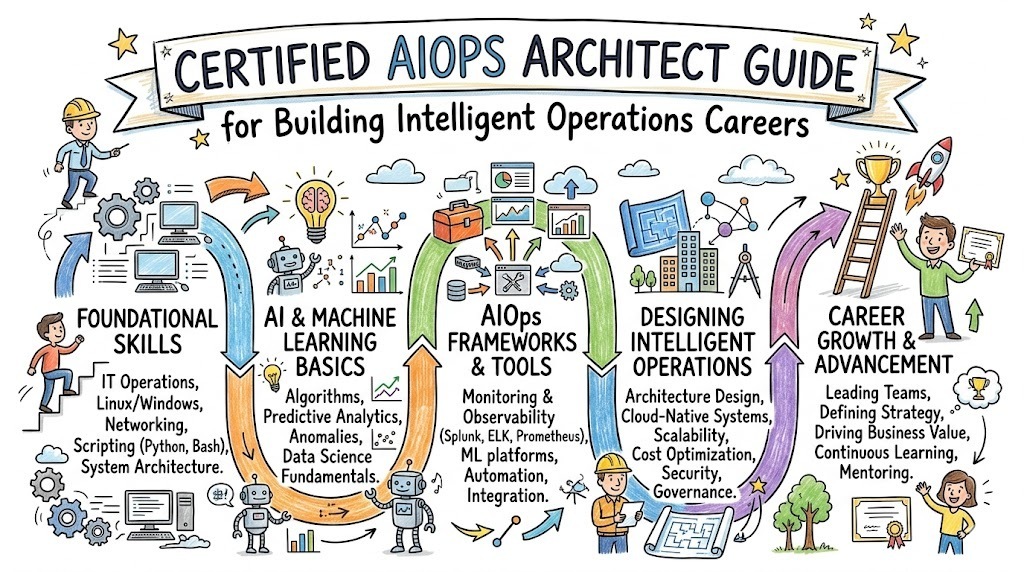
Introduction
The Certified AIOps Architect is designed for professionals who want to move beyond basic monitoring, alerting, and automation into enterprise-level AIOps strategy and architecture.In today’s IT environment, systems are large, distributed, cloud-based, and always changing. Traditional monitoring is no longer enough. Teams need intelligent systems that can collect signals, detect patterns, reduce noise, predict failures, support root cause analysis, and trigger safe automation.That is where AIOps becomes important.AIOps means Artificial Intelligence for IT Operations. It brings together AI, machine learning, observability, automation, incident management, cloud operations, and platform engineering. AIOps helps teams reduce manual work, improve uptime, and make faster decisions during incidents.The Certified AIOps Architect certification is offered by AIOpsSchool through the official certification page:According to the official certification page, the Certified AIOps Architect is an Expert / Architect level certification with an exam duration of 180 minutes, covering 60 MCQs plus an Architecture Design Challenge, with a 78% passing score, 3-year validity, and listed price of $899.
About Certified AIOps Architect
The Certified AIOps Architect validates your ability to design, plan, and lead enterprise-grade AIOps solutions.
This certification is not only for people who want to learn tools. It is for professionals who want to understand how AIOps fits into real business operations, production systems, cloud platforms, DevOps workflows, SRE practices, security operations, and automation strategy.
It is useful for:
- Software Engineers
- DevOps Engineers
- SREs
- Platform Engineers
- Cloud Engineers
- IT Managers
- Engineering Managers
- Observability Engineers
- Automation Engineers
- Infrastructure Architects
- Technical Leads
- AIOps/MLOps practitioners
The certification is especially useful for working engineers and managers in India and global markets who want to grow into architecture, leadership, or transformation roles.
Why AIOps Matters Now
Modern systems generate huge amounts of data.
Every application, server, container, database, API, cloud service, Kubernetes cluster, CI/CD pipeline, and security tool produces logs, metrics, traces, events, alerts, and user signals.
Without AIOps, teams often face:
- Too many alerts
- Repeated incidents
- Slow root cause analysis
- Manual troubleshooting
- High downtime
- Poor visibility across systems
- Dependency confusion
- Lack of predictive insights
- Weak incident learning
- Slow recovery
AIOps helps solve these problems by using data, automation, and intelligence.
Instead of only reacting to failures, teams can move toward:
- Early anomaly detection
- Alert noise reduction
- Event correlation
- Root cause analysis
- Incident prediction
- Automated remediation
- Capacity forecasting
- Service health intelligence
- Intelligent observability
- Self-healing infrastructure
For engineering leaders, AIOps is not just a technical topic. It is also a business topic. It improves reliability, customer experience, engineering productivity, cost control, and operational maturity.
Certification at a Glance
| Track | Level | Who it’s for | Prerequisites | Skills covered | Recommended order |
|---|---|---|---|---|---|
| AIOps | Expert / Architect | Software Engineers, DevOps Engineers, SREs, Platform Engineers, Cloud Architects, Managers | Good understanding of DevOps, cloud, monitoring, incident management, automation, and basic AI/ML concepts | AIOps architecture, observability, ML-driven operations, automation, incident intelligence, enterprise implementation, governance | After AIOps Foundation, AIOps Engineer, or AIOps Professional level learning |
Who Should Read This Guide
This guide is written for professionals who want to understand the value of the Certified AIOps Architect certification before choosing it.
You should read this guide if you are:
- A software engineer moving toward operations intelligence
- A DevOps engineer working with automation and monitoring
- An SRE responsible for reliability and incident response
- A cloud engineer managing distributed systems
- A platform engineer building internal developer platforms
- A manager responsible for uptime, cost, and team productivity
- A technical lead planning AIOps adoption
- A consultant helping companies modernize operations
- A professional in India or global markets looking for career growth in AI-driven operations
This certification is not meant only for beginners. It is best for people who already understand real IT systems and want to design smarter operational platforms.
What It Is
The Certified AIOps Architect is an expert-level certification focused on designing intelligent IT operations systems.
It helps learners understand how to build AIOps platforms that connect observability, automation, AI/ML models, incident workflows, cloud systems, and business reliability goals.
The certification is delivered by AIOpsSchool through its official certification platform.
Who Should Take It
You should consider this certification if you want to become confident in designing and leading AIOps solutions.
It is suitable for:
- DevOps professionals who want to move into AIOps architecture
- SREs who want to improve reliability using AI-driven insights
- Cloud engineers working with multi-cloud or hybrid environments
- Managers who want to understand AIOps strategy and adoption
- Software engineers who want to expand into operational intelligence
- Architects responsible for enterprise automation and observability
- Consultants supporting digital transformation projects
This certification is especially useful if your current role involves monitoring, incident handling, automation, platform reliability, or cloud operations.
Skills You’ll Gain
After preparing for this certification, you should gain strong understanding of:
- AIOps architecture design
- Enterprise observability strategy
- Logs, metrics, traces, and event correlation
- AI/ML use cases in IT operations
- Anomaly detection concepts
- Alert noise reduction
- Root cause analysis workflows
- Incident prediction and prevention
- Automated remediation design
- Self-healing system patterns
- Cloud-native AIOps implementation
- Kubernetes and container monitoring strategy
- Data pipelines for operational intelligence
- Governance and risk controls in automation
- AIOps adoption roadmap planning
- Tool selection and platform evaluation
- Reliability improvement using data-driven insights
- Collaboration between DevOps, SRE, platform, security, and business teams
Real-World Projects You Should Be Able to Do After It
After completing the learning path, you should be able to work on practical projects such as:
- Design an enterprise AIOps architecture for a cloud-based application
- Build an observability data pipeline using logs, metrics, traces, and events
- Create an alert correlation strategy to reduce alert fatigue
- Design a root cause analysis workflow for production incidents
- Plan anomaly detection for infrastructure and application behavior
- Build an automated remediation workflow with approval controls
- Create a service health dashboard for business and engineering teams
- Design a Kubernetes AIOps monitoring approach
- Plan multi-cloud incident intelligence architecture
- Map AIOps use cases to DevOps and SRE workflows
- Build an AIOps maturity roadmap for an organization
- Evaluate AIOps tools based on scalability, integrations, security, and cost
- Design governance rules for safe automation
- Create post-incident learning and continuous improvement workflows
Preparation Plan
7–14 Days Plan
This plan is suitable for experienced professionals who already understand DevOps, cloud, monitoring, and incident management.
Focus areas:
- Review AIOps fundamentals
- Understand observability signals: logs, metrics, traces, and events
- Study anomaly detection and event correlation basics
- Review incident management lifecycle
- Understand root cause analysis patterns
- Learn automated remediation concepts
- Review AIOps architecture diagrams
- Practice designing a simple AIOps platform
- Study governance and risk controls
- Attempt practice questions and architecture scenarios
Best for:
- Senior engineers
- DevOps leads
- SREs
- Cloud architects
- Managers with strong technical background
30 Days Plan
This plan is suitable for working engineers who can study regularly.
Week-wise focus:
First phase: Foundation refresh
- AIOps fundamentals
- DevOps and SRE connection
- Observability basics
- Monitoring challenges
- Alert fatigue and incident noise
Second phase: Architecture and data flow
- Data ingestion
- Logs, metrics, traces, events
- Data normalization
- Event correlation
- Service dependency mapping
- AIOps pipeline design
Third phase: Intelligence and automation
- Anomaly detection
- Root cause analysis
- Predictive operations
- Auto-remediation workflows
- Human approval gates
- Runbook automation
Fourth phase: Enterprise readiness
- Scalability
- Security
- Governance
- Integration strategy
- Multi-cloud support
- Architecture case studies
- Mock assessment practice
Best for:
- Mid-level engineers
- DevOps professionals
- SREs
- Software engineers moving into AIOps
- Technical managers
60 Days Plan
This plan is best for learners who want deep understanding and hands-on confidence.
Focus areas:
- AIOps concepts from basic to advanced
- DevOps, SRE, and cloud architecture alignment
- Observability platform design
- Data pipeline planning
- ML-driven operations use cases
- Incident intelligence design
- Automation safety and governance
- Platform integration planning
- Business value mapping
- Architecture documentation
- Real-world project practice
- Practice exam and review
Suggested learning flow:
- Start with AIOps fundamentals
- Build understanding of monitoring and observability
- Study incident management deeply
- Learn how AI/ML supports operations
- Understand architecture patterns
- Practice solution design
- Review enterprise constraints
- Prepare for MCQs and architecture design challenge
Best for:
- Software engineers new to AIOps
- Managers who want structured learning
- Cloud engineers moving into architecture
- Professionals preparing alongside work responsibilities
Common Mistakes
Many learners make the mistake of treating AIOps as only a tool-based topic. AIOps is not only about buying or using one tool. It is about designing a complete operational intelligence system.
Avoid these mistakes:
- Learning tool features without understanding architecture
- Ignoring data quality
- Depending only on alerts instead of service context
- Confusing monitoring with observability
- Ignoring incident workflow integration
- Automating remediation without safety checks
- Not involving DevOps, SRE, security, and business teams
- Forgetting governance and audit requirements
- Designing dashboards without actionability
- Treating AI/ML as magic instead of a support system
- Ignoring cost, scalability, and data retention
- Not preparing for architecture design scenarios
A good AIOps Architect must think beyond tools. The real skill is designing a safe, scalable, useful, and business-aligned AIOps system.
Best Next Certification After This
After completing Certified AIOps Architect, your next certification depends on your career direction.
Recommended next options may include:
- Certified MLOps Architect
- Certified SRE Architect
- Certified DevSecOps Architect
- Certified DataOps Architect
- Certified FinOps Architect
- Advanced cloud architecture certification
- Kubernetes or platform engineering certification
- Observability and reliability engineering certification
If your goal is AI-driven operations leadership, then moving toward MLOps, SRE, and Platform Engineering certifications can be a strong next step.
If your goal is management, then AIOps strategy, FinOps, and transformation leadership certifications can help.
Choose Your Path
Different professionals come to AIOps from different backgrounds. The best learning path depends on your current role and career goal.
1. DevOps Path
This path is for DevOps engineers who already work with CI/CD, automation, cloud, containers, and deployment pipelines.
Recommended focus:
- AIOps fundamentals
- Observability integration with CI/CD
- Incident automation
- Deployment failure analysis
- Change intelligence
- Auto-remediation
- DevOps-to-AIOps maturity roadmap
Best outcome:
You become capable of designing intelligent DevOps systems that detect issues faster and improve release reliability.
2. DevSecOps Path
This path is for professionals working with security, compliance, risk, and secure automation.
Recommended focus:
- Security event correlation
- Threat signal analysis
- Compliance monitoring
- Automated response with approval controls
- Risk-based incident prioritization
- Audit logs and governance
- Secure AIOps workflows
Best outcome:
You can help organizations connect security operations with intelligent automation and safer decision-making.
3. SRE Path
This path is for Site Reliability Engineers and reliability-focused teams.
Recommended focus:
- Service-level indicators
- Service-level objectives
- Error budgets
- Incident prediction
- Root cause analysis
- Reliability dashboards
- Self-healing infrastructure
- Post-incident learning
Best outcome:
You can use AIOps to improve uptime, reduce MTTR, and support reliability engineering at scale.
4. AIOps/MLOps Path
This path is for professionals who want to connect AI/ML systems with IT operations.
Recommended focus:
- ML-driven anomaly detection
- Model monitoring
- Data pipelines
- Operational intelligence
- AIOps model lifecycle
- Prediction quality
- Human-in-the-loop automation
- Continuous improvement
Best outcome:
You can work at the intersection of AI, ML, DevOps, and operations.
5. DataOps Path
This path is for data engineers, analytics engineers, and professionals working with data pipelines.
Recommended focus:
- Operational data ingestion
- Data quality for AIOps
- Event normalization
- Log analytics
- Observability data pipelines
- Data governance
- Analytics-driven decision-making
Best outcome:
You can build reliable data foundations for AIOps platforms.
6. FinOps Path
This path is for cloud cost, finance, and operations teams.
Recommended focus:
- Cloud cost anomaly detection
- Resource usage intelligence
- Capacity planning
- Cost-aware operations
- Forecasting
- Automated optimization recommendations
- Business impact dashboards
Best outcome:
You can connect AIOps with cloud cost optimization and business value.
Role-Based Recommendation
| Role | Why Certified AIOps Architect helps | Suggested focus |
|---|---|---|
| Software Engineer | Helps understand how code behaves in production | Observability, incident patterns, production feedback |
| DevOps Engineer | Improves automation and operational intelligence | CI/CD intelligence, remediation, monitoring |
| SRE | Supports reliability, prediction, and faster recovery | SLOs, root cause analysis, MTTR reduction |
| Cloud Engineer | Helps manage complex cloud systems intelligently | Multi-cloud observability, capacity, automation |
| Platform Engineer | Supports internal platform reliability | Service health, developer experience, platform signals |
| Manager | Helps plan AIOps adoption and team strategy | Roadmap, ROI, tool selection, governance |
| Architect | Supports enterprise-grade AIOps design | Scalability, integrations, security, architecture |
How Certified AIOps Architect Helps Your Career
The demand for intelligent operations is growing because companies want faster incident response, better reliability, and lower operational cost.
This certification can help you grow in roles such as:
- AIOps Architect
- DevOps Architect
- SRE Lead
- Platform Architect
- Cloud Operations Architect
- Observability Lead
- Automation Architect
- Technical Program Manager
- IT Operations Manager
- Reliability Engineering Manager
- Digital Transformation Consultant
For professionals in India, this can be useful because many organizations are moving toward cloud, DevOps, platform engineering, and AI-driven automation. For global professionals, AIOps skills are also useful because distributed systems, hybrid cloud, and automation challenges are common across industries.
Key Topics You Should Understand Before Certification
Before going deep into Certified AIOps Architect, you should be comfortable with:
- Basic Linux and infrastructure concepts
- Cloud computing fundamentals
- DevOps lifecycle
- CI/CD pipeline basics
- Monitoring and alerting
- Incident management
- Logs, metrics, and traces
- Kubernetes basics
- Automation scripts and runbooks
- Basic AI/ML concepts
- Security and governance basics
- System design thinking
You do not need to be a data scientist, but you should understand how AI/ML can help identify patterns, detect anomalies, and support decisions.
AIOps Architecture Mindset
A good AIOps Architect does not start with tools. They start with problems.
Important questions include:
- What incidents happen repeatedly?
- Which alerts are noisy?
- Which systems have poor visibility?
- Where does root cause analysis take too much time?
- Which manual actions can be safely automated?
- What business services are most critical?
- What data is available?
- What data quality issues exist?
- Which teams need to collaborate?
- What risks come with automation?
- How will success be measured?
AIOps architecture should connect people, process, data, tools, and automation.
The goal is not only to build a smart system. The goal is to build a useful system that improves real operations.
Top Institutions Providing Training cum Certifications for Certified AIOps Architect
DevOpsSchool
DevOpsSchool is known for training programs in DevOps, DevSecOps, SRE, Cloud, Kubernetes, and related engineering practices. It can help learners build the foundational DevOps and automation knowledge needed before moving deeper into AIOps architecture. For working professionals, DevOpsSchool can be useful for structured learning and practical orientation.
Cotocus
Cotocus provides consulting, training, and technology services around DevOps, automation, cloud, and digital transformation. Learners who want project-based exposure may find Cotocus useful because AIOps requires both technical knowledge and implementation thinking. It can support professionals who want to understand how enterprise automation works in real environments.
Scmgalaxy
Scmgalaxy has a strong focus on software configuration management, DevOps, CI/CD, build tools, release engineering, and automation practices. These areas are important for AIOps because operational intelligence depends on reliable software delivery and system visibility. It is useful for learners who want to strengthen their engineering foundation before architect-level AIOps learning.
BestDevOps
BestDevOps provides learning resources and training support around DevOps and modern IT practices. It can help learners understand the practical side of automation, monitoring, and operations. For Certified AIOps Architect preparation, such DevOps grounding is helpful because AIOps builds on DevOps maturity.
devsecopsschool
devsecopsschool focuses on DevSecOps learning, secure automation, security integration, and compliance-oriented engineering practices. This is important for AIOps because automated operations must be safe, auditable, and policy-driven. Learners interested in security-aware AIOps architecture can benefit from this direction.
sreschool
sreschool focuses on Site Reliability Engineering concepts, reliability practices, incident response, SLOs, error budgets, and production operations. These are directly connected to AIOps because AIOps supports faster detection, diagnosis, and recovery. For SREs, this is a strong supporting path before or after Certified AIOps Architect.
aiopsschool
aiopsschool is the official provider for the Certified AIOps Architect certification. It focuses on AIOps and MLOps training, certifications, consulting, and career-oriented learning. Since the certification is officially hosted by AIOpsSchool, learners should use the official certification page as the primary reference.
dataopsschool
dataopsschool focuses on data operations, data pipelines, analytics workflows, and data-driven engineering. This is helpful for AIOps because operational intelligence depends heavily on clean, connected, and reliable data. Learners who want to understand the data foundation of AIOps can benefit from DataOps learning.
finopsschool
finopsschool focuses on FinOps, cloud cost management, financial accountability, and cost optimization practices. This supports AIOps learning because modern operations are not only about uptime but also about efficient resource usage. AIOps Architects who understand FinOps can design smarter systems for both reliability and cost control.
Study Checklist for Certified AIOps Architect
Before attempting the certification, review this checklist:
- Understand what AIOps means
- Know the difference between monitoring and observability
- Understand logs, metrics, traces, and events
- Learn event correlation concepts
- Study anomaly detection basics
- Understand incident management workflows
- Know root cause analysis patterns
- Learn auto-remediation design
- Understand safe automation controls
- Study cloud and Kubernetes operations
- Learn AIOps architecture patterns
- Understand governance and compliance needs
- Practice architecture design scenarios
- Review real-world production incident examples
- Prepare for both MCQs and design-based questions
Practical Example: AIOps in a Real Organization
Imagine a company running an e-commerce platform.
The platform uses microservices, Kubernetes, cloud databases, payment APIs, caching, CDN, and CI/CD pipelines. During high traffic, users complain that checkout is slow.
Without AIOps, teams may check dashboards manually, search logs, compare metrics, open multiple tools, and discuss possible causes. This can take a long time.
With AIOps, the system can:
- Detect unusual latency
- Correlate checkout errors with database response time
- Identify recent deployment changes
- Compare current behavior with historical patterns
- Suppress duplicate alerts
- Suggest likely root cause
- Trigger a rollback recommendation
- Notify the correct team
- Create an incident summary
- Record learning for future prevention
This is the kind of thinking an AIOps Architect needs.
The role is not only to know tools. The role is to design an intelligent operating model.
Conclusion
The Certified AIOps Architect is a strong certification for professionals who want to move into intelligent operations, reliability architecture, automation leadership, and AI-driven IT transformation.
AIOps is becoming important because modern systems are too complex for manual monitoring alone. Teams need smarter ways to detect issues, reduce alert noise, understand root causes, predict failures, and automate safe recovery. This certification helps you build that architecture-level thinking.
For software engineers, it opens a path toward production intelligence and platform thinking. For DevOps engineers, it adds AI-driven automation and operational maturity. For SREs, it supports reliability improvement and faster incident response. For managers, it provides a structured way to understand AIOps strategy, adoption, and business value.
The best way to approach this certification is not to memorize tool names. Instead, understand real problems: noisy alerts, slow incident response, poor visibility, manual troubleshooting, and repeated outages. Then learn how AIOps architecture solves those problems using data, intelligence, automation, and governance.
If your goal is to become a future-ready engineer, architect, or technical leader, the Certified AIOps Architect can help you build a strong career direction in AI-powered operations.



Top comments (0)